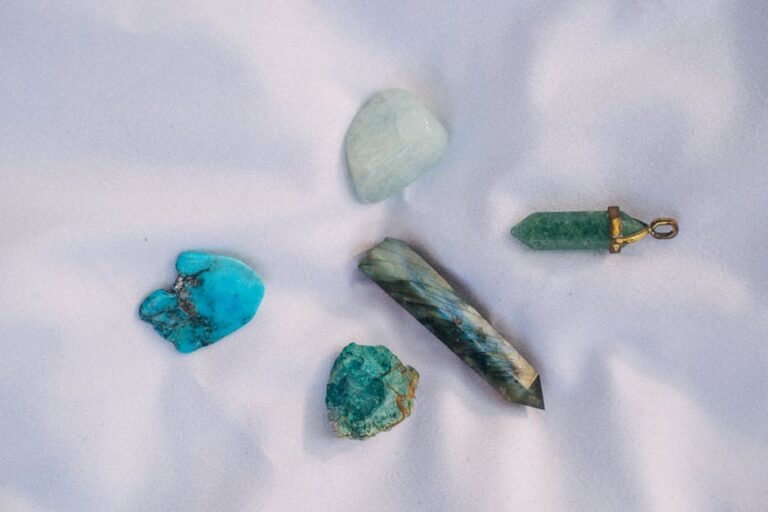
9 Blue Crystals: Meanings, Properties & Throat Chakra Healing
Blue crystals are the voice of the mineral kingdom. They are the stones of throat chakra healing, honest expression, intuitive insight, and the deep, settled calm that comes from speaking your truth without fear. Where red crystals ignite passion and green crystals open the heart, blue crystals do the patient work of clarifying communication, deepening wisdom, and connecting you to the still, sky-wide perspective of higher mind.
From lapis lazuli — the oldest spiritual stone in human history, mined in Afghanistan since 4000 BCE and worn by Egyptian pharaohs — to larimar, the Caribbean stone found on a single mountainside in the Dominican Republic, this color family carries an unusual depth of historical and cultural weight. Sapphire crowns the British monarchy. Aquamarine has been a sailor’s talisman against drowning for two thousand years. Azurite was Edgar Cayce’s “stone of heaven.” These are the crystals that humans have always associated with the sky, the sea, and the upper realms of consciousness.
This guide covers the 9 most powerful blue crystals and exactly how to use them — whether you are calming anxiety, preparing for a difficult conversation, deepening your meditation practice, or learning to trust your own intuition. Each crystal in this collection has its own personality, history, and energetic specialty. Use the comparison chart below to find the right stone for your situation, or read the full profiles to understand what makes blue one of the most spiritually significant color families in the entire crystal world.
Throat (Vishuddha) & Third Eye
Water, Air
Mercury, Neptune
Key Healing Properties
- Throat chakra activation and clear, honest communication
- Calming anxiety, fear, and emotional overwhelm
- Deepening intuition and third-eye spiritual insight
- Wisdom, mental clarity, and disciplined focus
- Speaking truth without aggression or defensiveness
- Meditation, dreamwork, and connection to higher consciousness
Blue Crystal Comparison Chart
Each blue crystal carries a different specialty within the throat chakra family. Use this quick-reference table to find the right stone for your intention:
The Best Blue Crystals and Their Meanings
1. Lapis Lazuli — The Stone of Wisdom and Royalty

Lapis lazuli is the oldest spiritual stone on record — used in ancient Sumer, Egypt, and Mesopotamia for over 6,500 years. Tutankhamun’s burial mask was inlaid with lapis. Cleopatra ground it into the world’s first eyeshadow. Renaissance painters crushed it to make ultramarine, the most expensive blue pigment in history, reserved for painting the Virgin Mary’s robes. The deep midnight blue flecked with golden pyrite has always been associated with kings, gods, and the upper realms of the sky.
In modern healing, lapis lazuli is the stone of inner truth and royal authority. It activates both the throat chakra for honest expression and the third eye for spiritual insight, making it the go-to crystal for writers, teachers, public speakers, and anyone whose work depends on speaking truth with confidence. Practitioners place it on the brow during meditation to access deeper wisdom, or wear it daily as a quiet reminder to lead with integrity.
Geological note: lapis lazuli is technically a rock, not a single mineral — it is composed primarily of lazurite (the blue), with calcite (the white veining) and pyrite (the gold flecks) inclusions. The finest grade comes from the Sar-i Sang mines of Afghanistan, where lapis has been continuously mined for over 6,000 years — making it one of the oldest active mining operations on Earth.


💎 Premium Lapis Lazuli Collection
Natural Rocks by Kala — Sterling Silver & Genuine Lapis Lazuli
Handcrafted 925 sterling silver jewelry with natural Afghan lapis lazuli


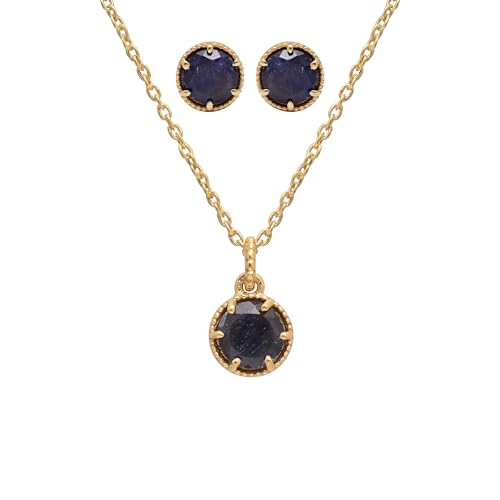
2. Sapphire — The Stone of Wisdom and Divine Favor

Sapphire is the second-hardest natural mineral on Earth — only diamond is harder — and that durability is why royal crowns from Persia to England have featured sapphires for over a thousand years. The British Crown Jewels include the famous St. Edward’s Sapphire, dated to 1042, set in the cross atop the Imperial State Crown. Princess Diana’s engagement ring (now Kate Middleton’s) features a 12-carat Ceylon sapphire that has launched a thousand modern engagement trends.
As the September birthstone, sapphire carries the energy of focused wisdom and divine favor. Medieval clerics wore sapphire rings believing they kept impure thoughts at bay. Buddhist scholars associated it with the search for spiritual truth. Practitioners today use sapphire to deepen meditation, sharpen intuition, and maintain mental discipline during demanding intellectual work — it is the stone you reach for when you need to think clearly under pressure.
Geological note: sapphire is a variety of corundum (aluminum oxide). Pure corundum is colorless — sapphire’s blue comes from trace iron and titanium impurities that absorb red and yellow wavelengths through a process called intervalence charge transfer. The same mineral colored by chromium produces ruby; in fact, sapphire and ruby are the same mineral with different impurities.

3. Aquamarine — The Stone of Courage and Calm Communication

Aquamarine takes its name from the Latin aqua marina — “sea water” — and looking at a polished aquamarine in sunlight makes the reason obvious. The pale blue-green color is the exact shade of shallow tropical water, which is why Roman sailors carried it as a talisman against shipwreck and drowning. Greek mythology held that aquamarine was the treasure of mermaids, washed ashore from sirens’ chests for sailors to find.
As the traditional birthstone for March, aquamarine governs the throat chakra and is the most powerful crystal for clear, courageous communication. Public speakers, teachers, mediators, and anyone who has to deliver difficult news rely on aquamarine to speak from a calm center rather than from fear or anger. It is also the traditional anniversary gift for the 19th year of marriage — a symbol of long-term emotional clarity.
Geological note: aquamarine is the blue-green variety of beryl (the same mineral family as emerald), colored by iron. Where emerald gets its green from chromium, aquamarine’s color comes from Fe2+ ions creating a charge-transfer effect that absorbs red light. The largest gem-quality aquamarine ever found weighed 243 pounds and produced over 200,000 carats of cut stones.


4. Sodalite — The Logic and Truth Stone

Sodalite was first identified in 1811 in Greenland and named for its sodium content. It looks remarkably similar to lapis lazuli at first glance — a deep royal blue with white veining — but lacks lapis’s signature golden pyrite flecks. Princess Patricia of Connaught popularized sodalite in 1901 when she chose it to decorate Marlborough House in London, and the stone has been associated with quiet, intelligent elegance ever since.
Sodalite is the logic stone. While lapis governs creative inspiration and sapphire rules disciplined wisdom, sodalite is the crystal of structured analytical thinking — the kind of clear-headed reasoning needed for research, study, writing, and complex problem-solving. Practitioners place sodalite on desks during work that requires sustained mental focus, or carry tumbled stones into exam rooms and meetings. It works on both the throat chakra (honest expression of ideas) and the third eye (mental clarity).
Sodalite is also one of the few crystals traditionally recommended for emotional regulation during conflict — it helps you respond rather than react, and hold a logical position without becoming defensive. For students and lifelong learners, a small sodalite point on the desk is a quiet daily ally.


5. Blue Lace Agate — The Gentle Healer of the Throat Chakra

Blue lace agate is one of the gentlest stones in the entire mineral kingdom — pale sky blue banded with delicate white lace patterns that look exactly like a frozen wave. It was first discovered in southwest Africa in the 1960s, making it a relative newcomer to the crystal world, but it has rapidly become a staple of throat-chakra healing because of its uniquely calming energy. Where harder blue stones like sapphire and lapis carry intense royal authority, blue lace agate offers something quieter: tender support for anyone afraid to speak.
Practitioners use blue lace agate specifically for situations where speaking the truth feels too vulnerable — recovering from trauma, ending an unhealthy relationship, telling a parent something they don’t want to hear, or simply asking for help. The stone is especially valued for children, sensitive adults, and people healing from verbal abuse. It works on the throat chakra with the kind of patient softness that makes self-expression feel safe.
Geological note: blue lace agate is a banded chalcedony (microcrystalline quartz) colored by trace elements within concentric layers laid down inside cooled volcanic gas pockets. The “lace” comes from rhythmic crystallization over thousands of years — each band marks a slightly different chemical environment as the stone slowly grew.


6. Larimar — The Caribbean Stone of Serene Power

Larimar is one of the rarest gemstones on Earth — found in exactly one place on the planet: a single mountainside in the Dominican Republic, in a remote area of the Bahoruco Mountains. It was officially identified in 1974 by a Dominican named Miguel Méndez, who combined his daughter Larissa’s name with mar (the Spanish word for sea) to create the name “Larimar.” Local legend long held that the stone came from the ocean — and they were partially right. Larimar is a rare blue variety of pectolite, formed when volcanic gases reacted with the surrounding rock millions of years ago.
The colors of larimar look like a Caribbean lagoon photographed from above: turquoise, sea-green, and white swirled together in patterns no two pieces share. Practitioners associate larimar with feminine power, divine wisdom, and the lost continent of Atlantis (a common metaphysical attribution for unique blue-green stones). It is the stone for healers, mothers, and women in positions of leadership who need to balance authority with deep compassion.
In throat chakra work, larimar is unique for combining the assertiveness of sapphire with the gentleness of blue lace agate. It helps you speak with both confidence and care — useful for difficult diagnoses, breaking news, or holding space for grief. Because it is mined from a single source, supply is limited and prices have steadily risen; authentic larimar is now considered a collector’s gemstone.


7. Blue Apatite — The Manifestation and Motivation Stone

Blue apatite gets its strange name from the Greek word apatáō (to deceive) — early mineralogists kept mistaking it for other stones. The mistake was understandable: apatite comes in nearly every color imaginable. The blue variety is the most prized, and unlike the soft tropical blue of aquamarine, blue apatite has an intense, almost neon teal-blue that practically glows. Most gem-quality blue apatite comes from Madagascar, Brazil, and Mexico.
Blue apatite is the manifestation stone of the blue family. It works on both the throat chakra (clear communication of intentions) and the third eye (visioning future outcomes), bridging the two centers in a way few other stones can. Practitioners use it specifically for goal-setting work, motivation slumps, and the kind of personal discipline required to follow through on long-term projects. It is also a famous appetite-suppressant stone — the connection to its name has come full circle, since “apatite” sounds like “appetite,” and modern healers associate it with conscious eating and weight management.
Practical note: blue apatite is relatively soft (Mohs 5) compared to other blue stones, so handle it carefully if you wear it as a ring or bracelet. Many people prefer it as a pendant or pocket stone for daily use, where it stays close enough to do its motivational work without risk of chipping.


8. Azurite — The Stone of Heaven and Inner Vision

Azurite is the most intense natural blue mineral on Earth — a deep cobalt-to-violet blue so saturated it almost looks unreal. Ancient Egyptians considered it the stone of priests and pharaohs, used to access higher consciousness during temple ceremonies. The ancient Greeks and Romans crushed azurite into pigment, and Renaissance painters used it as a cheaper alternative to ultramarine before chemical pigments replaced it in the 18th century. Edgar Cayce, the famous American psychic, called azurite the “stone of heaven” and recommended it for meditation work.
In healing tradition, azurite is the third-eye stone of the blue family. Where lapis carries authority and sapphire brings discipline, azurite opens visionary states — meditation, channeling, clairvoyance, and the kind of deep intuitive work that bypasses the rational mind. Practitioners often use a single piece during meditation by holding it between the brows and waiting for the stone to “do its work,” which can include unusual visual experiences and profound emotional release.
Geological and safety note: azurite is a copper carbonate (chemically related to malachite, and the two are often found together as “azurite-malachite”). Like malachite, azurite contains copper and should never be made into elixirs, soaked in water, or handled extensively when raw. Polished and sealed azurite jewelry is safe for normal wear, but always wash hands after handling specimens.


9. Blue Kyanite — The Energy Aligner That Never Needs Cleansing

Blue kyanite is one of only two crystals in the entire mineral kingdom (along with citrine) that practitioners say never needs cleansing or charging — it does not absorb negative energy, so it has nothing to release. This unusual property is rooted in kyanite’s unique crystal structure: it forms in long bladed crystals that practically vibrate with directional energy. Hold a piece up to the light and you can see the parallel fibers running through it like frozen lightning.
In healing work, blue kyanite is the chakra-aligning stone. Practitioners run it slowly along the body to clear blockages and restore the flow between energy centers. It is especially valuable for the throat chakra, where it helps with self-expression, telepathy, and communication with spirit guides — but unlike most throat-chakra stones, kyanite also activates and balances all the other chakras at once. This makes it a favorite of energy healers, Reiki practitioners, and meditators.
Geological note: kyanite has the unusual property of having two different hardnesses depending on the direction of measurement — about 4.5 along its length but 6.5 across the crystal. This anisotropic hardness made early mineralogists call it “disthene” (Greek for “two strengths”). Blue is the most common color, ranging from pale sky to deep indigo, but kyanite also occurs in green, black, and rare orange varieties.


What Makes Crystals Blue?
Blue is one of the rarer natural mineral colors — less common than green, brown, or black — which is part of why blue stones have always carried such prestige across cultures. The color almost always comes from one of three mechanisms: iron-titanium charge transfer (the deep blues of sapphire and benitoite), copper compounds (the cobalt of azurite, the turquoise of larimar and turquoise itself), or structural defects in the crystal lattice that absorb red and yellow wavelengths and reflect only blue back.
In sapphire, the iconic cornflower blue comes from trace iron and titanium impurities working together inside a corundum crystal. When an electron jumps between an iron and a titanium atom, it absorbs yellow light — leaving the blue we see. Replace those impurities with chromium and the same crystal becomes ruby. Aquamarine is colored by Fe2+ ions inside a beryl structure (the same mineral family as emerald), creating a charge-transfer effect that produces its pale tropical color.
Lapis lazuli takes a completely different route — the deep blue comes from sulfur ions trapped inside the crystal structure of lazurite, the dominant mineral in lapis. This unusual sulfur-based blue is what made lapis the source of ultramarine pigment for thousands of years before synthetic blues were invented. Azurite and turquoise get their colors from copper ions in different chemical environments. Sodalite’s royal blue, like lapis, comes from sulfur and aluminum within its silicate framework.
Larimar is the strangest blue stone of all: it is a copper-rich variety of pectolite found in only one place on Earth, where ancient volcanic activity created the precise chemistry needed to produce its Caribbean colors. Blue lace agate and most chalcedony blues come from very small amounts of trace iron in the silica structure, with the lace patterns formed by rhythmic crystallization over thousands of years. The diversity of these mechanisms is why blue crystals span such an extraordinary range — from the diamond-hard sapphire to the soft, water-soluble azurite.
Our Top Pick

How to Use Blue Crystals
Throat chakra meditation. Lie down and place a blue crystal — aquamarine, blue lace agate, or larimar — directly on the hollow at the base of your throat. Breathe slowly, and on each exhale silently say one true thing you have not allowed yourself to say out loud. This is the fastest way to clear a blocked throat chakra and reconnect with honest expression.
Pre-meeting preparation. Before a difficult conversation, public speaking, or any high-stakes communication, hold a piece of sodalite or aquamarine for two minutes while you mentally rehearse what you need to say. Both stones support clear thinking under pressure and help you stay calm even if the conversation gets tense. Carry one in your pocket throughout the meeting itself.
Bedside intuition support. Place lapis lazuli or azurite under your pillow (or on the nightstand) to encourage vivid, meaningful dreams. Lapis is famous for prophetic dreams; azurite for visionary meditation states. Many practitioners report unusually clear dream recall after working with blue stones for several nights in a row. Pair with other sleep crystals like amethyst for deeper rest.
Anxiety relief. Carry blue lace agate or larimar in a pocket throughout the day for chronic anxiety. The gentle, watery energy of these soft blue stones is uniquely effective for fight-or-flight responses, panic, and the kind of low-level dread that builds up over busy weeks. Hold them in your palm during anxious moments and consciously slow your breathing. A blue lace agate bracelet keeps the support close all day.
Study and analytical work. Place sodalite or sapphire on your desk during periods of intense study, research, or writing. Both stones support disciplined mental focus — sodalite for analytical reasoning and sapphire for sustained concentration. Many writers and researchers swear by a single sodalite point in their workspace as a quiet productivity ally.
Energy healing and chakra alignment. Blue kyanite is the master alignment tool of the blue family. Lay a piece across each chakra in turn (root to crown), holding for one minute each, to clear blockages and restore energetic flow. Unlike most crystals, kyanite never needs cleansing — it does not absorb negative energy in the first place, making it perfect for daily Reiki and healing work.
Shop Blue Crystal Bracelets
✨ Curated Crystal Collection
Blue Crystal Bracelets from Energy Muse


🛒 Also Available on Amazon
Shop Blue Crystal Jewelry


Frequently Asked Questions
What are blue crystals good for?
Blue crystals are throat chakra healers — they specialize in clear communication, honest self-expression, calming anxiety, deepening intuition, and supporting wisdom and disciplined focus. Each blue crystal has its own specialty: lapis lazuli for inner truth, sapphire for mental discipline, aquamarine for courageous speech, blue lace agate for gentle expression, and larimar for feminine power. For daily throat chakra support, a genuine aquamarine bracelet keeps the energy close.
Which blue crystal is best for the throat chakra?
Aquamarine is traditionally considered the most powerful throat chakra crystal — specifically for courageous, calm communication. It is also the birthstone for March and the traditional gift for the 19th wedding anniversary. For very gentle throat chakra work (especially for trauma recovery, anxiety, or speaking up after a long silence), blue lace agate is softer and equally effective. Larimar sits between the two — assertive but compassionate — and is the favorite of many healers and women in leadership.
What is the most powerful blue crystal?
It depends on what you need. For wisdom and inner truth, nothing surpasses lapis lazuli — the oldest spiritual stone in human history. For mental discipline and divine favor, sapphire is unmatched. For visionary meditation and third-eye work, azurite is the deepest. For energy alignment without needing to cleanse, only blue kyanite works. The “most powerful” blue crystal is the one matched to your specific intention — check the comparison chart above to find your match.
How do I cleanse blue crystals?
Most blue crystals respond well to moonlight, sound bath cleansing, or selenite plates. Important exceptions: never soak azurite in water (its copper content makes it unsafe and the surface will degrade), and avoid prolonged sunlight for aquamarine, blue lace agate, and amethyst, which can fade. Lapis lazuli should not be soaked either — the calcite veining and sulfur compounds can react. Blue kyanite is unique: it never needs cleansing because it does not absorb negative energy in the first place. Smoke cleansing with sage or palo santo is safe for all blue crystals.
What chakra do blue crystals work with?
Blue crystals primarily activate the throat chakra (Vishuddha), the energy center governing communication, self-expression, and speaking your truth. Many blue stones also work with the third eye chakra (intuition and inner vision): lapis lazuli, sapphire, sodalite, and azurite all bridge throat and third eye, making them ideal for anyone who needs to communicate ideas clearly while staying connected to deeper insight. Blue kyanite is exceptional — it activates all chakras at once and is the master alignment stone of the blue family.
Are blue crystals good for anxiety?
Yes — several blue crystals are among the most calming stones in the entire mineral kingdom. Blue lace agate is the gentlest, ideal for chronic anxiety, panic, and trauma recovery. Aquamarine has a cooling, watery energy that soothes overheated emotions. Larimar combines calm with quiet confidence, making it perfect for performance anxiety. Carry one of these in your pocket throughout the day, hold it during anxious moments, and consciously slow your breathing. For more options, see our complete crystals for anxiety guide.
Related Crystal Guides
- Crystal Color Meanings: Complete Guide →
- Black Crystals and Their Meanings →
- Red Crystals and Their Meanings →
- Orange Crystals and Their Meanings →
- Yellow Crystals and Their Meanings →
- Green Crystals and Their Meanings →
- Purple Crystals and Their Meanings →
- Pink Crystals and Their Meanings →
- White Crystals and Their Meanings →
- Brown Crystals and Their Meanings →
- Throat Chakra Crystals →
- Crystals for Anxiety →
- Best Crystals for Meditation →
- Crystals for Sleep →
- Azurite Meaning & Properties →
- Pisces Birthstone Guide (Aquamarine) →
- Virgo Birthstone Guide (Sapphire) →
- Sagittarius Birthstone Guide (Lapis Lazuli) →
- How to Cleanse Crystals →
- Zodiac Crystals: Complete Guide →
Sources & References
- The Crystal Bible by Judy Hall. Walking Stick Press.
- The Encyclopedia of Crystals by Judy Hall. Fair Winds Press.
- The Book of Stones by Robert Simmons & Naisha Ahsian. North Atlantic Books.
- Crystal Muse by Heather Askinosie & Timmi Jandro. Hay House.
- Gemological Institute of America (GIA) — Gem Encyclopedia.
- Mindat.org — Mineral Database.
Last Updated on April 11, 2026
We may earn a commission from links on this page at no extra cost to you. This helps us keep CrystalsAlchemy running.
This article was originally published on