
Tiger’s Eye Meaning, Properties & Benefits Guide
This post contains affiliate links. If you purchase through these links, we may earn a small commission at no extra cost to you.
Two thousand years ago, Roman legionnaires marched into battle with tiger’s eye stones engraved into their armor and fastened around their wrists. They believed the stone’s fierce, golden bands channeled the courage of the tiger itself — that its shifting luminosity would blind enemies and protect the soldier’s life. Archaeological records document the use of this golden-brown gem as a talisman of war across the ancient world, and the tradition of carrying tiger’s eye for strength and protection has persisted across cultures ever since. Shop Handmade Tiger Eye on Amazon
Tiger’s eye crystal is one of the most recognizable stones in the mineral kingdom, distinguished by its warm golden-brown hues and a mesmerizing optical phenomenon known as chatoyancy — a silky, shifting luster that resembles the slit pupil of a cat’s eye. But beyond its visual beauty, tiger’s eye meaning runs deep: this is a stone associated with courage, confidence, willpower, and mental clarity. Whether you’re drawn to its striking appearance or its long tradition as a stone of personal power, tiger’s eye properties offer something genuinely compelling for both collectors and practitioners alike.
In this guide, I’ll walk you through everything you need to know about tiger’s eye — from its geological origins and historical significance to its metaphysical benefits and practical uses. I’ve worked with this stone for years, and I continue to recommend it to anyone seeking grounded confidence and clear-eyed determination.


Recommended Tiger Eye Products
These hand-picked products are selected for quality and value. As an Amazon Associate, we earn from qualifying purchases.


The Ancient History of Tiger’s Eye Crystal
Few stones carry as storied a history as tiger’s eye. Its use as a protective talisman dates back at least two millennia, and its cultural footprint spans continents. Understanding where this crystal has been helps illuminate why it remains so powerfully resonant today.
Our Top Tiger Eye Picks
We’ve hand-picked these products based on quality, reviews, and value. Prices and availability are updated regularly via the Amazon API.
Recommended Tiger’S Eye Products
Hand-picked for quality, reviews, and value — enhance your tiger’s eye experience.


Prices updated via Amazon. As an affiliate, we earn from qualifying purchases.
Roman Soldiers, Egyptian Pharaohs, and the Stone of Warriors
The Romans prized tiger’s eye above nearly all other protective stones. Military historians have noted that Roman soldiers would engrave the stone with images of Mars, the god of war, and wear them as protective amulets going into battle. The belief was that tiger’s eye granted the wearer the all-seeing vision of the tiger, allowing them to anticipate threats and respond with decisive, grounded courage. Unlike softer gemstones that shattered under hard use, the stone’s durability made it well-suited for warriors who needed a talisman that could endure the rigors of campaign. Shop Tiger Eye Pendant on Amazon
In ancient Egypt, tiger’s eye was associated with the divine eye of Ra, the sun god. Egyptian craftsmen used chatoyant stones to represent divine vision in the carved eyes of deity statues. The Smithsonian National Museum of Natural History holds several ancient Egyptian amulets fashioned from chatoyant stones that share characteristics with tiger’s eye, pointing to its long history as a sacred object of spiritual protection. Egyptian priests believed that the stone’s shifting eye-like band was literally a window through which the gods watched over and guided the wearer.
Across Asia, particularly in ancient China and India, tiger’s eye was incorporated into traditional healing and protective practices. Chinese craftsmen carved it into small figurines and protective seals, while Indian Ayurvedic traditions referenced chatoyant stones as materials that balanced the solar energies of the body. These historical records, spanning multiple continents and millennia, underscore a remarkably consistent cross-cultural reverence: tiger’s eye has always been understood as a stone of fierce, protective vision.
The Discovery of South African Tiger’s Eye Deposits
For much of history, tiger’s eye was relatively scarce, sourced in limited quantities from locations in Asia and the Middle East. That changed dramatically in the late 19th century when massive deposits were discovered in the Northern Cape province of South Africa, particularly in the Griqualand West region near the town of Griquatown. These South African deposits remain among the largest and most commercially significant in the world and are responsible for much of the tiger’s eye available in the global market today.
The discovery coincided with a broader Victorian-era fascination with gemstones and natural curiosities, and tiger’s eye quickly became popular in decorative arts, jewelry, and the emerging Western interest in crystal healing. Today, South African tiger’s eye is recognized for its deep, saturated golden-brown coloration and exceptional chatoyancy — qualities that have made it the benchmark against which other sources are measured.

Tiger’s Eye Properties: The Science Behind the Stone
Tiger’s eye is a metamorphic rock — specifically, a pseudomorph of quartz after crocidolite, also known as blue asbestos. According to Mindat.org, tiger’s eye forms when silica-rich groundwater replaces fibrous crocidolite mineral deposits, preserving the original fibrous structure while converting the material to quartz. This replacement process is what creates the stone’s characteristic silky, parallel fibrous architecture — and it is precisely this structure that produces chatoyancy.
From a mineralogical standpoint, tiger’s eye is a variety of macrocrystalline quartz with a chemical composition of SiO₂ (silicon dioxide) and traces of iron oxide, which impart the stone’s signature golden-brown coloration. The Gemological Institute of America (GIA) notes that tiger’s eye is prized primarily for its optical phenomenon rather than its transparency, making it one of the few gem materials whose value is defined almost entirely by a single physical effect. Shop Crystal Bracelet on Amazon
Chatoyancy: Nature’s Optical Illusion
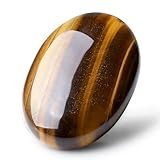
The defining physical property of tiger’s eye is its chatoyancy — from the French oeil de chat, meaning cat’s eye. This effect occurs when light reflects off the parallel fibrous inclusions within the stone, creating a single bright band that moves fluidly across the surface as the viewing angle changes. In high-quality tiger’s eye specimens, this band is crisp, centered, and travels smoothly from one end of the polished stone to the other.
Chatoyancy is best observed in cabochon-cut stones — that dome-shaped, unfaceted cut that gem cutters use specifically to maximize this optical effect. Research published in the Journal of Gemmology has explored how the intensity of chatoyancy in fibrous quartz varieties is directly related to the density and parallelism of the inclusions. Stones with tightly packed, highly aligned fibers produce the sharpest and most visually striking cat’s-eye effect.
On the practical side, tiger’s eye registers 6.5 to 7 on the Mohs hardness scale, making it durable enough for everyday wear in bracelets, pendants, and rings. It has a vitreous to silky luster and typically occurs in massive form rather than well-defined crystals, which is why you’ll most often see it as tumbled stones, polished palm stones, and cabochon jewelry rather than as points or clusters.
Geographic Sources of Tiger’s Eye
The primary commercial sources of tiger’s eye include:
- South Africa — The Northern Cape province remains the world’s largest producer, known for deep golden-brown specimens with exceptional chatoyancy and rich iron oxide saturation.
- Australia — Significant deposits exist in Western Australia, particularly in the Hamersley Range, producing stones with slightly warmer, more reddish-gold tones.
- India — Indian tiger’s eye, often sourced from Rajasthan and Madhya Pradesh, tends toward lighter golden hues and is widely available through US crystal retailers and online marketplaces.
- Myanmar (Burma) — Burmese tiger’s eye is considered among the finest quality, though export volumes are limited relative to South African production.
- Namibia and Brazil — Smaller deposits yield stones with distinctive color variations, including some unusually deep brown-gold tones.
In the United States, tiger’s eye is not commercially mined domestically but is widely available through crystal shops in cities like Los Angeles, New York, Denver, Austin, and Seattle, as well as through gem and mineral shows — the annual Tucson Gem and Mineral Show in Arizona and the Denver Gem Show are particularly excellent sources for evaluating quality in person.


Tiger’s Eye Meaning and Metaphysical Properties
Tiger’s eye occupies a distinctive place in the crystal healing tradition — it is simultaneously a stone of action and a stone of grounded wisdom. Unlike some crystals that work primarily on the emotional or spiritual planes, tiger’s eye meaning is fundamentally about manifesting inner power in the physical world. Its energy is direct, practical, and motivating. This is not a passive stone — it asks you to move. Shop Tiger Eye Necklace on Amazon
Tiger’s Eye Benefits for Courage and Confidence
The most universally recognized tiger’s eye benefit is its association with courage and self-confidence. Practitioners report that working with tiger’s eye helps dissolve self-doubt and hesitation, replacing them with a sense of grounded determination. This is not the reckless courage of adrenaline — it’s the steady, clear-eyed confidence that comes from knowing your own capabilities and trusting your instincts to guide you through uncertainty.
In my experience, tiger’s eye is particularly useful for people who struggle with decision paralysis or who find themselves holding back out of fear of failure or judgment. The stone seems to encourage a quality of honest self-assessment followed by committed action — not bravado, but backbone. Those looking to build this quality more broadly will find our article on crystals for confidence helpful, as several stones pair beautifully with tiger’s eye in this work. And if your intention is specifically oriented toward building courage in the face of challenge — a difficult conversation, a career transition, or a personal test of character — our guide to crystals for courage explores complementary stones that amplify this intention further.
Protection and Energetic Grounding
Tiger’s eye has long been used as a protective crystal, a use that traces directly back to its ancient warrior heritage. Crystal practitioners traditionally believe it creates an energetic buffer around the wearer, deflecting negative energy, psychic interference, and the draining effects of other people’s fear or anger, while simultaneously keeping the wearer grounded and present in their own center.
From a chakra perspective, tiger’s eye is primarily associated with the solar plexus chakra — the energy center located just above the navel that governs personal power, self-worth, and the capacity for decisive action. It also carries a secondary association with the root chakra, which provides the grounding quality that keeps its activating properties from becoming destabilizing. This dual connection is part of what makes tiger’s eye so effective: it energizes without untethering, and it protects without contracting.
Tiger’s Eye for Mental Clarity and Focus
Beyond its warrior reputation, tiger’s eye meaning includes a strong association with mental clarity and focused, analytical thinking. Practitioners often reach for it when they need to cut through confusion, evaluate complex situations with greater objectivity, or make decisions that require weighing competing priorities without being paralyzed by them. The stone is traditionally believed to sharpen the mind’s capacity to distinguish between what is essential and what is distraction — a quality as relevant in a modern workplace as it ever was on an ancient battlefield.
This makes tiger’s eye a popular companion for students, writers, executives, and anyone navigating a high-stakes decision period. Many practitioners keep a piece on their desk or hold it during focused work sessions to anchor their attention and maintain mental stamina through demanding tasks. Shop Handmade Tiger Eye Jewelry on Amazon
Tiger’s Eye Varieties: Understanding the Different Types
Tiger’s eye is not a single uniform stone — it exists in several natural and treated varieties, each with its own color characteristics and traditional metaphysical associations. Understanding these differences helps you make an intentional choice when selecting a stone.
| Variety | Color | Primary Association | Chakra | Best For |
|---|---|---|---|---|
| Golden Tiger’s Eye | Golden-brown to amber | Courage, willpower, confidence | Solar Plexus, Root | Decision-making, motivation, energetic protection |
| Red Tiger’s Eye (Ox Eye) | Deep red to reddish-brown | Passion, vitality, physical drive | Root, Sacral | Physical energy, overcoming lethargy, grounding passion |
| Blue Tiger’s Eye (Hawk’s Eye) | Blue-gray to blue-green | Clarity, calm communication, insight | Throat, Third Eye | Reducing anxiety, improving communication, intuition |
| Green Tiger’s Eye | Green-gold to olive | Growth, abundance, heart-centered action | Heart, Solar Plexus | Financial confidence, practical abundance work |
The most widely available variety — and the one most people refer to simply as tiger’s eye — is the classic golden-brown type sourced primarily from South Africa. Red tiger’s eye, also called bull’s eye or ox eye, is typically formed by gently heat-treating golden tiger’s eye; this process intensifies the iron oxide content and shifts the color toward deep red-brown. Blue tiger’s eye, or hawk’s eye, is the rarest natural variety, preserving more of the original crocidolite blue-gray coloration in the replacement process. According to the Smithsonian National Museum of Natural History, hawk’s eye and tiger’s eye represent different stages of the same pseudomorphic replacement process — hawk’s eye forms when the replacement is incomplete, retaining the crocidolite’s blue color alongside the silica. Green tiger’s eye is the rarest and is sometimes produced through irradiation or dyeing, so it is worth verifying the source when purchasing.
How to Use Tiger’s Eye for Courage and Confidence
One of the most appealing qualities of tiger’s eye is its versatility. This is a crystal that works well in nearly any format — worn as jewelry, carried in a pocket, used in meditation, or placed in a home or workspace. Here are the most effective methods I’ve worked with over the years.
Wearing Tiger’s Eye Jewelry
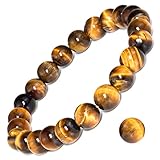
Wearing tiger’s eye directly against the skin is one of the most time-honored ways to work with its properties. Bracelets are particularly popular because they keep the stone in continuous contact with the pulse points on the wrist. Many practitioners wear tiger’s eye on the left wrist — traditionally considered the receiving side — when they want to draw in its grounding and protective energy, and on the right wrist — the giving or projecting side — when they want to radiate confidence outward in social or professional situations.
Tiger’s eye pendants worn near the solar plexus are another effective choice, particularly for those working specifically on personal power and self-worth. The stone’s warmth and weight against the body serve as a continuous physical anchor for the intention you’ve set with the stone.
 n Adjustable” rel=”nofollow noopener sponsored” target=”_blank”>
JOVIVI Healing Crystals Necklace Natural Yellow Tiger Eye Lucky Blessing Protection Chakra Beads Stone Pendant for Women Men Adjustable
n Adjustable” rel=”nofollow noopener sponsored” target=”_blank”>
JOVIVI Healing Crystals Necklace Natural Yellow Tiger Eye Lucky Blessing Protection Chakra Beads Stone Pendant for Women Men Adjustable

Meditating with Tiger’s Eye
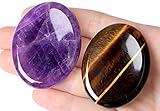
For meditation, I recommend holding a tiger’s eye palm stone in your dominant hand, or placing a tumbled piece directly on your solar plexus chakra as you lie down in a relaxed position. Begin with several slow, deep breaths to settle your nervous system, then allow your awareness to rest gently on the warmth and texture of the stone. Shop Tiger Eye Bracelet on Amazon
A simple tiger’s eye meditation for cultivating courage: visualize the golden bands within the stone as rivers of warm light flowing into your core, filling the center of your body with steady, grounded energy. With each exhale, consciously release fear, self-doubt, or hesitation — let them move out of your body with the breath. With each inhale, receive the stone’s quiet, unwavering confidence. Hold this visualization for ten to fifteen minutes. Over time, this practice builds a genuine felt sense of the stone’s energy that you can access even when you’re not holding it.
Tiger’s Eye in Crystal Grids and Intention Work
Tiger’s eye functions beautifully as an anchor stone in crystal grids designed around themes of personal power, courage, career success, or protection. Its grounding earth energy provides stability and directional focus to the grid’s overall intention, making it an ideal choice for the center stone or for the outer anchor points of a protective layout. Pair golden tiger’s eye with carnelian for motivation and driven action, with citrine for work oriented toward confident abundance, or with black tourmaline for a strong boundary-setting and protection grid. Those new to this practice will find our crystal grids for beginners guide an invaluable starting point.
How to Choose and Care for Your Tiger’s Eye Crystal
Identifying Authentic Tiger’s Eye
The crystal market, like any market involving visually striking goods, has its share of imitations. The most common tiger’s eye substitutes are glass and dyed synthetic materials that mimic the chatoyant effect. Here is how to identify genuine tiger’s eye with confidence:
- Temperature response: Authentic tiger’s eye feels cool to the touch initially and warms slowly as it absorbs heat from your hand. Glass warms more rapidly and uniformly.
- Chatoyancy quality: Real tiger’s eye displays a silky, organic luster — the band of light moves fluidly as you rotate the stone under a single light source. In glass imitations, the effect tends to appear more uniform and glitter-like rather than smooth and undulating.
- Weight: Tiger’s eye is denser than glass at comparable sizes. Genuine specimens feel substantial and solid in the hand.
- Fibrous texture under magnification: Authentic tiger’s eye shows a fine parallel fibrous texture clearly visible under a loupe or jeweler’s magnifying glass. Glass is uniformly smooth without this internal structure.
- Price as a signal: Genuine tiger’s eye is widely available and not prohibitively expensive. However, a price that seems dramatically too low for a large, high-quality, deeply chatoyant specimen is worth scrutinizing carefully.
Cleansing and Charging Your Tiger’s Eye
Tiger’s eye is a relatively robust stone that tolerates most common cleansing approaches. Here is what I recommend and what to avoid:
Safe cleansing methods for tiger’s eye: A brief rinse under cool running water (avoid extended soaking), smoke cleansing with sage, palo santo, or cedar, sound cleansing with singing bowls or tuning forks, moonlight exposure, and placement near a selenite charging slab. Our comprehensive guide on how to cleanse crystals covers all of these methods in detail and helps you choose the right approach for your situation.
One important care note: avoid prolonged water submersion for tiger’s eye. The stone’s iron content can oxidize over time with extended soaking, potentially causing surface discoloration or subtle structural changes. A brief rinse under cool running water for cleansing purposes is perfectly fine — leaving it submerged for hours or overnight is not recommended. Shop Tiger Eye Pendant Necklace on Amazon
For charging, sunlight is particularly resonant for tiger’s eye given its solar plexus associations and its warm golden color. A few hours in direct morning sunlight will amplify its energy meaningfully. You can also charge it on a selenite plate or place it in proximity to a large clear quartz cluster overnight. Store tiger’s eye in a soft pouch or a padded compartment to protect its polished surface. While it’s hard enough to resist most casual scratching, keep it separated from softer stones to avoid damaging them, and away from harder materials like topaz or diamond that could scratch its surface.


Bringing Tiger’s Eye Into Your Practice
Tiger’s eye is one of those rare crystals that genuinely delivers on its ancient reputation. Whether you’re drawn to it for its geological marvel — that extraordinary chatoyancy that has captivated humans across millennia and continents — or for its traditional properties of courage, clarity, and protection, this is a stone that earns its place in any collection, from the most minimal to the most extensive.
I keep a piece of tiger’s eye on my work desk and wear a bracelet on mornings when I know the day calls for steady, grounded confidence. It doesn’t promise magic — no crystal does — but it offers something more practical: a tangible, beautiful anchor for the intentions you’re actively cultivating. And sometimes, that anchor is exactly what you need to stop hesitating and start moving.
If you’re just beginning to explore the world of healing crystals, tiger’s eye is an excellent foundational stone — affordable, durable, widely available, and genuinely beautiful to work with. Start with a tumbled specimen or a simple bracelet, set a clear intention with it, and notice over time how the stone’s presence shifts your relationship to your own inner resources. For guidance on building a broader crystal practice from the ground up, our crystals for beginners guide is the ideal next step.
Last Updated on March 21, 2026
Amber, a certified crystal healer and spiritual teacher, shares her decade-long expertise on CrystalsAlchemy.com. Passionate about the transformative power of crystals, she helps others lead balanced lives through personal growth, spiritual development, and holistic well-being.
Related Posts:


We include products we think are useful for our readers. If you buy through links on this page, we may earn a small commission at no extra cost to you.
All content is strictly for informational purposes only and does not constitute legal, medical or other expert advice.
This article was originally published on
Looking for the perfect gift idea this holiday season? Try this free Gift Suggestion Tool. Giftly.ai is an intuitive tool personalizes gift suggestions based on a person's interests and your budget, streamlining your shopping experience. Try it now, and experience the ease of finding the ideal gift in seconds!


