Crystals for Studying: 8 Best Stones for Focus, Memory & Mental Clarity (2026)
Most study advice ignores what is actually on your desk. The lamp. The half-cold coffee. The phone you keep flipping over and somehow ending up in. The crystals for studying tradition, at its most useful, is not magic. It is a small, reliable system of tactile and visual anchors that help you sit down, settle, and stay with the page. Practitioners reach for crystals for focus and crystals for mental clarity because the rituals around them work the way good study habits work. A real object, in a specific place, used the same way every session, becomes a cue. This guide covers eight stones (real mineralogy, not just lore), how to use each one, what to grab on exam day, and the small cleansing rules that keep them working.
In This Guide
- Why Crystals for Studying Work (Focus, Memory & Mental Clarity)
- 8 Best Crystals for Studying at a Glance
- Fluorite: The Genius Stone for Focus
- Amethyst: The Calm-Focus Stone for Anxious Studiers
- Clear Quartz: The Crystal for Mental Clarity (Master Amplifier)
- Sodalite: The Logic Stone for Verbal & Written Exams
- Citrine: The Memory & Motivation Stone
- Carnelian: The Anti-Procrastination Stone
- Tiger’s Eye: The Exam-Day Confidence Stone
- Hematite: The Anti-Distraction Phone-Detox Stone
- How to Use Crystals While Studying
- How to Choose Your Study Crystal
- Cleansing & Caring for Study Crystals
- Frequently Asked Questions
- Sources & References
Why Crystals for Studying Work (Focus, Memory & Mental Clarity)
Crystals for studying are stones traditionally used to support focus, memory retention, and mental clarity during learning. The most common picks (Fluorite, Amethyst, Clear Quartz, Sodalite, Citrine, Carnelian, Tiger’s Eye, and Hematite) cover focus, calm, motivation, exam confidence, and grounding. Used as desk-top anchors, pocket stones, or pre-study meditation tools, they function as tactile cues for sustained attention, not as cognitive enhancers in any clinical sense.
The reason this tradition has stuck around is simple. Ritual plus tactile object plus consistent placement is one of the more reliable focus tools humans have. The placebo and ritual effect is well-documented in psychology, and a small, beautiful object on your desk that means “now I work” is a cue you can train. Crystals are not the only thing that does this. They are unusually good at it, though. They sit heavy in the hand. They catch light. They do not buzz, they do not notify you, and they do not show you a stranger’s life in another country. That alone makes them valuable.
There is a system to the eight stones that follow. They are not a random list. Each one anchors a different chakra, which means they cover different parts of the studying problem:
- Root (Hematite): grounded body, no doom-scrolling
- Sacral (Carnelian): drive, anti-procrastination
- Solar Plexus (Citrine, Tiger’s Eye): confidence, will, exam-day clarity
- Throat (Sodalite): structured thinking, verbal logic
- Third Eye (Fluorite, Amethyst): focus, calm-mind
- Crown (Clear Quartz): mental clarity, amplification
Most practitioners I know build two sub-kits from this set. A daily-study kit (Fluorite for focus, Clear Quartz for clarity, Amethyst for the night-before sleep) handles the long slow weeks. An exam-day kit (Tiger’s Eye for confidence, Carnelian for drive, Hematite for grounding) handles the morning of. You do not need all eight to start. You need the one that maps to whatever specifically tends to derail you.
8 Best Crystals for Studying at a Glance
If you only have time to skim, here is the comparison. The eight best crystals for studying, side by side, with the property data and the one-line “best for” tag that tells you which one to pick first.
| Crystal | Mineral / Mohs | Best for | Chakra | Color | How to Use |
|---|---|---|---|---|---|
| Fluorite | CaF₂ / Mohs 4 | Focus, mental clarity | Third Eye | Green, purple, rainbow | Octahedron on desk |
| Amethyst | Quartz / Mohs 7 | Calm focus, exam anxiety | Crown / Third Eye | Violet | Cluster on desk, tumbled under pillow |
| Clear Quartz | Quartz / Mohs 7 | Mental clarity, amplifier | Crown | Clear | Point on desk, facing your work |
| Sodalite | Tectosilicate / Mohs 5.5–6 | Logic, verbal exams | Throat | Royal blue | Tumbled in pocket |
| Citrine | Quartz / Mohs 7 | Memory, motivation | Solar Plexus | Yellow to amber | Cluster on desk |
| Carnelian | Chalcedony / Mohs 7 | Anti-procrastination | Sacral | Orange-red | Tumbled in pocket |
| Tiger’s Eye | Quartz / Mohs 7 | Exam-day confidence | Solar Plexus | Gold-brown | Pocket on test day |
| Hematite | Iron oxide / Mohs 5.5–6.5 | Grounding, anti-distraction | Root | Metallic gray | Hand-held during reading |
Why this particular eight, and not some other roster? Because they form a coherent column from root to crown. Stack any subset and the energetics still make sense. Most listicles throw fifteen stones at the problem and let you sort it out. This set is small enough to actually use, and complete enough to cover focus, calm, drive, confidence, logic, and grounding in one sweep.
Fluorite: The Genius Stone for Focus
If you read one stone in this list, read this one. Fluorite is the most-recommended crystal for studying across every practitioner tradition I know of, for one simple reason. It works as a focus anchor in a way few other stones do.
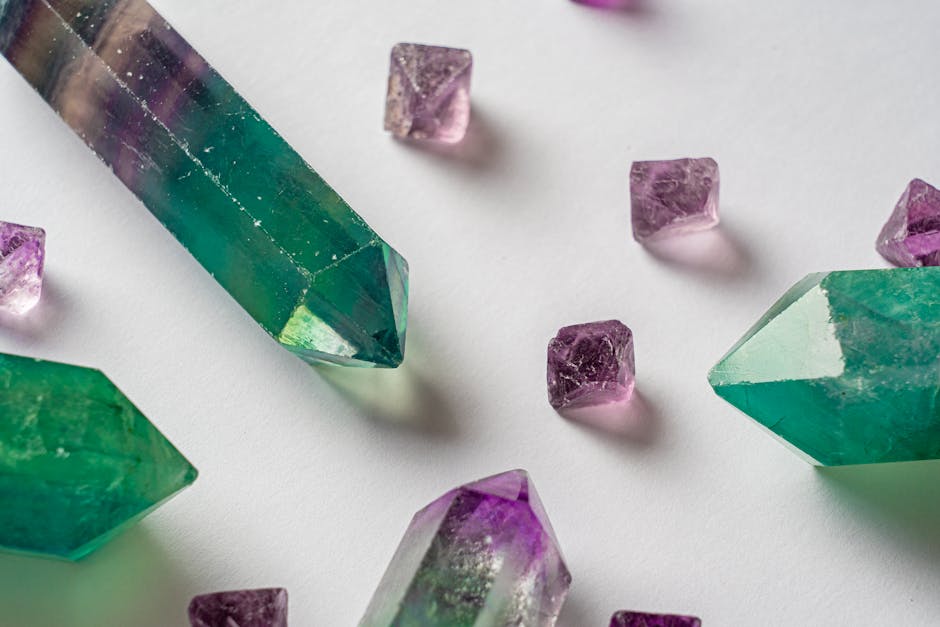
Mineralogy. Fluorite is calcium fluoride, CaF₂. Mohs hardness 4, which means handle gently and no keychains. It crystallizes in the cubic system, but the most beautiful specimens form natural octahedrons (eight-sided). Here is the geology fact almost no other studying-crystal post mentions. Fluorite has four perfect cleavage planes, which makes it the only common mineral with four directions of perfect cleavage. That octahedral break habit is not a happy accident. It is built into the structure. Pure fluorite is colorless. The greens, purples, blues, and pinks come from trace elements (yttrium for green, color centers from radiation for purple) and from rare earth substitutions in the lattice.
The name comes from Latin fluere, “to flow,” because fluorite was used as a flux in metallurgy to lower iron’s melting point. The scientific term fluorescence was named after fluorite, because the mineral glows blue, purple, or white under ultraviolet light. The structure is, literally, a textbook example of orderly arrangement: each Ca²⁺ ion sits surrounded by eight F⁻ ions, in a perfect cubic close-packed array.
Why it helps studying. Practitioners reach for fluorite for studying when scattered thinking is the problem. The structural orderliness of CaF₂ is the metaphor that holds. Tradition associates the stone with bringing thought into a clean shape, and the “Genius Stone” nickname comes from that.
How to use it. A green fluorite octahedron on your desk is the classic move. Rainbow fluorite (banded green and purple) is good for variety projects across subjects. Purple fluorite leans into memorization work.
Pairing. Fluorite and Clear Quartz is the classic study duo. Fluorite organizes, Clear Quartz amplifies.
I keep a green fluorite octahedron next to my keyboard. The eight flat triangular faces give my eyes something to land on between paragraphs, and the mass of it (heavy for its size, the way good fluorite is) keeps my hand from drifting toward the phone. That is the whole job, and it does it.
✨ Featured Pick from Energy Muse

A genuine purple fluorite carving — purple fluorite is the variety practitioners reach for when memorization is the goal. The flower form gives a sculptural focal point on the desk; cleavage faces catch the light when you glance up.
Shop at Energy Muse →Amethyst: The Calm-Focus Stone for Anxious Studiers
Amethyst is the stone you reach for when the problem is not focus. It is the racing mind that has to settle before focus is even possible. Most students who think they need a focus stone actually need an anxiety-regulation stone first. Amethyst is that stone.
Mineralogy. Amethyst is silicon dioxide, SiO₂, a violet variety of macrocrystalline quartz. Mohs 7. The purple color comes from iron impurities (Fe³⁺ and Fe⁴⁺) plus natural gamma irradiation deep in the earth. Heat amethyst to about 470°C and it turns yellow. That is citrine. The amethyst-citrine continuum is, chemically speaking, the same stone in two color states. Most commercial citrine on the market is heat-treated amethyst from Brazil. Major amethyst sources are Brazil (Rio Grande do Sul geode mines), Uruguay, and Zambia.
Why it helps studying. Tradition holds that amethyst calms anxiety, soothes overthinking, and steadies the nervous system. The crown-chakra association comes from the violet ray. For studying purposes, the practical use is this: it pulls down the volume on the inner monologue so you can hear the page.
How to use it. A small amethyst cluster on the desk is a daily anchor. A tumbled amethyst stone under your pillow the night before an exam is the traditional move for sleep quality, which matters more than any crystal you put in your pocket the morning of.
Pairing. Amethyst and Fluorite is the classic anxious-student stack. Amethyst regulates the nerves, Fluorite organizes the mind that is left.
If exam anxiety is the specific thing standing between you and the work, this is where I would start.
✨ Featured Pick from Energy Muse

A small amethyst cluster mounted on a copper stand — the exact “cluster on the desk” the daily-study tradition asks for. Copper conducts and carries; the stone sits at eye-line so you do not lose track of it.
Shop at Energy Muse →Clear Quartz: The Crystal for Mental Clarity (Master Amplifier)
Clear quartz is the most versatile stone in the studying kit and the one that earns the “Master Healer” label across nearly every practitioner tradition. For students, the use case is specific. Amplification of intent, and direction of mental clarity.
Mineralogy. Pure SiO₂. Mohs 7. Trigonal crystal system. Here is the fact almost no other crystals-for-mental-clarity post will tell you. Quartz is piezoelectric. Apply pressure to a quartz crystal and it generates an electric charge. Apply an electric field and it vibrates at a precise, fixed frequency. This is not metaphysical. It is the reason every quartz watch keeps time, every radio oscillator stays on frequency, and every cell phone has a tiny synthetic quartz oscillator inside it. The same mineral structure that runs the timing of your watch is the one sitting on your desk.
That is a mineralogy hook with weight. The metaphor for “amplification” actually holds in physics. This stone really does take a tiny input (pressure) and convert it into a regular, repeatable output (frequency). Whether the metaphysical claim of “amplifying intention” follows from this is a matter of belief, not mineralogy. The mineralogy itself is impressive enough.
Why it helps studying. Practitioners use clear quartz to clarify thinking and to amplify whatever stone it is paired with. For crystals for mental clarity work specifically, this is the anchor stone in the kit.
How to use it. A clear quartz point on your desk, facing toward your work, is the traditional placement. The point directs the energy toward the task. Holding a tumbled quartz during pre-study meditation is the secondary use.
Pairing. Clear Quartz amplifies whatever colored stone you stack with it. Pair it with Fluorite for focus amplification, with Amethyst for calm amplification, and with Citrine for memory amplification.
✨ Featured Pick from Energy Muse

A natural clear quartz carved into the Sri Yantra (the geometric symbol of focused intention). Sacred geometry plus piezoelectric quartz — about as on-the-nose as a study stone gets.
Shop at Energy Muse →Sodalite: The Logic Stone for Verbal & Written Exams
Sodalite is the stone you reach for when the work is structural. Outlines. Oral presentations. Language exams. Anything where the problem is not absorbing material but organizing it for output.
Mineralogy. Sodalite is a tectosilicate with the formula Na₈(Al₆Si₆O₂₄)Cl₂, a member of the feldspathoid group. Mohs 5.5 to 6, which makes it softer than quartz and more vulnerable to scratches. It crystallizes in the isometric (cubic) system. The deep royal-blue color comes from the internal framework structure plus sulfur impurities.
A small history detail almost no competitor mentions: Princess Margaret of Connaught chose sodalite to clad the interior of Marlborough House in 1901, which sparked a fashion for “Princess Blue” sodalite from the Bancroft, Ontario deposit. That single decoration project put sodalite on the map as a decorative stone in the West.
Sodalite is often confused with lapis lazuli. The distinction is this: sodalite is one of the minerals that occurs in lapis (along with lazurite and pyrite), but pure sodalite is more uniformly blue and lacks the gold pyrite flecks that make lapis recognizable.
Why it helps studying. Practitioners associate sodalite with the throat chakra and structured verbal thought. The tectosilicate framework structure (a 3D lattice of linked silica tetrahedra) is the metaphor. Orderly architecture for orderly thinking. It is the stone for outlines, presentations, and oral exams more than for content absorption.
How to use it. A tumbled sodalite stone in the pocket during oral exams or presentations. On the desk during outline drafting or essay-structuring sessions.
I reach for sodalite when I have to outline rather than absorb. The two states feel different, and the stone is a small reminder of which one I am supposed to be in.
Citrine: The Memory & Motivation Stone
Citrine is the solar-plexus stone in the studying kit. Drive, will, motivation, and the recall side of memory. It pairs naturally with Carnelian on the motivation axis and with Fluorite on the focus axis.
Mineralogy. Citrine is silicon dioxide, SiO₂, a yellow-to-amber variety of quartz with Fe³⁺ as the chromophore. Mohs 7.
Honest disclosure most practitioner blogs skip: most “citrine” sold in the market is heat-treated amethyst from Brazil. The treatment is industry-standard and has been since the 1950s. It involves heating amethyst to about 470°C, which oxidizes the iron and produces the yellow-amber color. Natural citrine is rarer and tends toward a paler, smokier yellow. It comes mostly from Madagascar and Russia. Both natural and heat-treated work the same way for metaphysical purposes (the iron is the same iron, just in a different oxidation state), but a Collector reader will appreciate knowing which one they have. Heat-treated citrine is fine. It just is not “natural citrine,” and the cheap bright-orange points labeled “citrine” almost always are not.
Why it helps studying. Practitioners use citrine for motivation breakthroughs, manifestation work, and the recall side of memory. The “good grades” trope around citrine lives in this lane. Citrine is also the stone most often associated with academic success in modern practitioner traditions.
How to use it. A citrine cluster on your desk for daily drive. A tumbled citrine in the pocket on exam day.
Pairing. Citrine and Carnelian is the procrastination breakthrough stack. Citrine and Fluorite is the focus-plus-recall pair.
✨ Featured Pick from Energy Muse

A solid citrine pendant on a chain — wearable academic-success energy. Citrine is the stone most often associated with academic success in modern practitioner traditions; on the body, the stone stays in contact through the day.
Shop at Energy Muse →Carnelian: The Anti-Procrastination Stone
Carnelian is for the specific problem of “I keep losing momentum.” If you sit down to study, get five minutes in, then drift, then need ten more to come back, this is your stone.
Mineralogy. Carnelian is a variety of chalcedony, which is cryptocrystalline quartz: SiO₂ in microscopic interlocking crystals rather than the visible single crystals of regular quartz. Mohs 7. The orange-red color comes from iron oxide inclusions distributed through the chalcedony matrix.
Treatment note: a great deal of commercial “carnelian” on the market is heat-treated agate or chalcedony from Brazil. The heat oxidizes the iron and deepens the color. Naturally deep-saturated carnelian comes mostly from India and Madagascar. Both are real carnelian (the iron content is genuine), but the saturated commercial carnelian you see in tumbled-stone bins has usually been helped along.
The historical context is exceptional. Ancient Egyptians wore carnelian as a stone of motivation and protection for warriors; the famous carnelian thumb rings of the pharaohs are still in museum cases today. The Roman tradition of intaglio signet rings, used to seal letters and contracts, was almost entirely carnelian. The stone takes a fine carved impression, and the wax does not stick to it. Carnelian has been the working stone of ambitious people for at least 4,000 years.
Why it helps studying. Sacral-chakra drive. Practitioners use it to push through stuck-momentum patterns and procrastination loops.
How to use it. A tumbled carnelian in the pocket during long study sessions, or on the desk for big-project work where the issue is sustained drive over weeks.
Pairing. Carnelian with Citrine for the procrastination breakthrough kit. Carnelian with Tiger’s Eye for exam-day drive plus confidence.
✨ Featured Pick from Energy Muse

A carnelian Power Bracelet — wearable sacral-chakra drive. Confirmed converter at Energy Muse and a strong fit for the “I keep losing momentum” pattern. On the wrist, it is in your peripheral vision every time you reach for the keyboard.
Shop at Energy Muse →Tiger’s Eye: The Exam-Day Confidence Stone
Tiger’s Eye is THE exam-day stone in the practitioner tradition. The reason is specific: it works on the courage-under-pressure axis, not the focus axis. You bring this one for the morning of, not the daily slog.
Mineralogy. Tiger’s Eye is one of the most fascinating stones in this list from a geology perspective, and almost no practitioner blog covers what it actually is. The chatoyancy (the cat’s-eye optical effect that gives it the moving “eye” of light) comes from fibrous crocidolite asbestos pseudomorphs replaced by silica. In other words: the original mineral was crocidolite, a fibrous variety of riebeckite (a sodium amphibole). Over millions of years, silica-rich solutions replaced the crocidolite fibers atom by atom, leaving the parallel fibrous structure intact but the chemistry now SiO₂. Light reflecting off the parallel silicified fibers creates the cat’s-eye shimmer.
It is not dangerous to handle. The asbestos has been fully replaced by quartz; what you hold is silicified pseudomorph, not asbestos. Mohs 7. Iron oxidation produces the gold-brown banding. Blue Tiger’s Eye (sometimes called Hawk’s Eye) is the unaltered crocidolite still showing through. Red Tiger’s Eye is heat-treated.
Why it helps studying. Solar-plexus confidence and clarity under pressure. Practitioners associate Tiger’s Eye with grounded courage, the kind that holds when the test is in front of you. It is also tied to the “crystals to wear during exams” and “crystals for test taking” tradition specifically because of this.
How to use it. A tumbled Tiger’s Eye in the front pocket of whatever you are wearing on test day. Always the dominant-hand pocket, traditionally.
Pairing. Tiger’s Eye with Carnelian for confidence plus drive. Tiger’s Eye with Hematite for the full exam-day grounded-courage shield.
On exam days, a tumbled tiger’s eye in the front pocket of whatever I’m wearing. Always.
✨ Featured Pick from Energy Muse

A natural tiger’s eye carved into a diamond shape — small enough for the exam-day pocket, finished enough that the chatoyancy reads in low light. Geometry plus gold-brown banding plus weight.
Shop at Energy Muse →Hematite: The Anti-Distraction Phone-Detox Stone
Hematite does not get the attention it deserves in the crystals-for-studying conversation, and that gap is where it earns its place in this kit. Hematite is the stone for the modern study problem nobody else is naming. The phone.
Mineralogy. Hematite is iron(III) oxide, Fe₂O₃. Mohs 5.5 to 6.5. Trigonal crystal system. The streak (the color of the powdered mineral) is always rust-red, regardless of whether the specimen looks metallic-gray, black, or red on the outside. That is the defining diagnostic test for hematite.
Here is the line that lands. Hematite is the iron oxide that gives Mars its red surface. The red planet is red because of finely powdered hematite covering it. When you hold a hematite stone, you are holding the same mineral that wraps an entire planet.
Honest note about magnetic hematite: pure hematite is only weakly magnetic (paramagnetic). Most of the magnetic hematite jewelry sold in the market is synthetic ferrite, a man-made magnetic iron oxide ceramic that is sintered and shaped to look like hematite. It is not lying about being iron oxide; it is lying about being natural. If your hematite bracelet sticks firmly to a fridge magnet, it is almost certainly synthetic. Real hematite drags weakly at most. The audience appreciates this kind of honesty, and I would rather you know.
Why it helps studying. Root-chakra grounding. The phone-distraction stone. Hematite is dense, cold, and physically heavy in a way that is unusual among crystals. When your hand reaches for the phone, that weight in your palm pulls you back. It is a tactile re-anchor. No competitor frames it this way; this is the gap.
How to use it. Hold during long reading sessions. Place on the desk between you and your phone (yes, physically between). Never put hematite in water; it rusts.
Pairing. Hematite with Tiger’s Eye is the exam-day grounded-courage shield.
Hematite is the stone I hand to anyone who tells me they keep checking their phone every five minutes. The weight does something.
✨ Featured Pick from Energy Muse

A selenite specimen with natural hematite inclusions — the cleansing stone of the kit paired with the grounding one. Pure hematite (not synthetic ferrite) embedded in selenite, which means it self-charges. Holds the phone-distraction line.
Shop at Energy Muse →How to Use Crystals While Studying
Five placement methods, plus the daily-kit and exam-day-kit distinction. This is the practical operating manual.
- Desk corner near dominant hand. The default daily-study setup. Right-handed studier puts the focus stone (Fluorite, Clear Quartz) in the upper-right corner of the desk, in clear sightline. Left-handed studier mirrors. The stone becomes a peripheral cue. Glance over, refocus, return to the page.
- Pocket or pencil case. The portable focus method. A tumbled stone (Tiger’s Eye, Carnelian, Sodalite) in the front pocket of jeans, or in the pencil case. Touch it when you need to come back to the work. Best for library sessions, classes, and anywhere you cannot set up a desk altar.
- Hand-held during reading. This is Hematite specifically. The cold weight in your palm is the entire point. Hold it while reading dense material; the tactile load shifts attention out of the head and into the body. Phone-detox stone, working as designed.
- Pre-study meditation, five minutes. Sit, hold the stone of the day, set a single intention out loud or silent (“focus for the next 90 minutes” or “absorb chapter four”). Then start. The ritual is not the magic. The consistency of the ritual is. Five minutes, every session, same stone. Within two weeks the cue is trained.
- Under the pillow, night before exam. Amethyst specifically. The point is sleep quality, which matters more for next-day performance than any pocket stone. A tumbled amethyst beside the bed or under the pillow is the traditional move.
The two sub-kits to pull from this set:
- Daily-study kit: Fluorite (focus) + Clear Quartz (clarity) + Amethyst (calm). The long-haul team for daily study and sustained productivity.
- Exam-day kit: Tiger’s Eye (confidence) + Carnelian (drive) + Hematite (grounding). The morning-of team.
The full eight-stone set, laid out chakra-by-chakra, gives you a complete column from root to crown. Hematite at the base. Carnelian above. Citrine and Tiger’s Eye at solar plexus. Sodalite at throat. Fluorite and Amethyst at third eye. Clear Quartz at crown. You do not need all eight on the desk at once. Pick the ones that map to whatever specifically tends to derail you that week.
How to Choose Your Study Crystal
Match the stone to the problem, not the reverse:
- Anxiety, racing mind: Amethyst
- Procrastination, momentum loss: Carnelian
- Phone distraction, doom-scroll loop: Hematite
- Oral exam, presentation, outline work: Sodalite
- Cannot focus or sustain concentration: Fluorite
- Daily productivity, long study weeks: Fluorite plus Clear Quartz on the desk
- Need to recall under pressure: Citrine plus Fluorite stacked
- Exam day morning: Tiger’s Eye in the pocket
A few quality notes worth knowing. Octahedral fluorite (natural break shape) is preferable to dyed or color-treated material; check that the green is even and the cleavage faces are matte, not too glossy. Natural citrine is paler than the bright-orange points labeled “citrine”; both work for the tradition, but the pricing should reflect which one you are buying. Tumbled stones (smooth, polished) are more comfortable in pockets. Raw clusters and points are better for desk display.
Budget tier guidance: tumbled stones run $5 to $15. Small clusters and points run $30 to $80. Collector-grade specimens run $200 and up. A starter kit of three tumbled stones (one daily-study, one exam-day, one pocket-anywhere) costs less than a textbook.
Cleansing & Caring for Study Crystals
Cleansing methods that are safe for the full kit: moonlight (full-moon overnight is canonical), sound (a singing bowl or a tuning fork), dry sage smoke, and selenite-plate contact. These four work for every stone in this list.
What to avoid: salt baths damage softer stones and porous stones (Sodalite especially). Prolonged direct sunlight fades the color of Amethyst, Citrine, and Fluorite (the iron and color-center chromophores are unstable to UV over time). A few minutes of morning sun for charging is fine. An afternoon on a south-facing windowsill is not.
Water rules, by stone:
- Safe in water: Clear Quartz, Amethyst, Citrine, Tiger’s Eye, Carnelian. The quartz family is hard enough (Mohs 7) and chemically stable enough to handle brief water exposure.
- Avoid water: Sodalite (porous, fades), Hematite (rusts; iron oxide plus water plus air equals more iron oxide), Fluorite (Mohs 4, prone to surface etching with prolonged immersion).
- When unsure, dry-cleanse. Moonlight, sound, or sage will not damage any stone in this list.
Charging: moonlight is the universal charge for this kit. Sunlight is acceptable briefly for Citrine, Carnelian, and Tiger’s Eye (warm-color stones with stable chromophores), but never for Amethyst or Fluorite.
Don’t put hematite in water. I made that mistake once. Ask me about the rust ring on my windowsill.
Frequently Asked Questions
What crystal helps with studying?
Fluorite is the most-recommended crystal for studying across practitioner traditions, often called the Genius Stone for its association with focus and structured thinking. The broader study kit also includes Clear Quartz (mental clarity), Amethyst (calm focus), Sodalite (logic), Citrine (memory and motivation), Carnelian (anti-procrastination), Tiger’s Eye (exam confidence), and Hematite (grounding).
What is the best crystal for studying?
Fluorite is the standard answer, with Clear Quartz a close second. Fluorite handles the focus and concentration side; Clear Quartz handles the mental clarity and amplification side. The two stones together (a fluorite octahedron and a clear quartz point on the desk) is the classic study setup.
Which crystal is good for memory and focus?
For memory specifically, Citrine is the traditional pick (associated with recall and solar-plexus confidence). For focus, Fluorite is the standard. Layered together, Citrine and Fluorite cover both sides of the studying problem.
How do you use crystals while studying?
Four placements cover most use cases: a focus stone on the desk corner near your dominant hand, a tumbled stone in your pocket for portability, a hand-held grounding stone (usually Hematite) during dense reading, and an Amethyst beside or under the pillow the night before an exam. Five minutes of pre-study meditation with the chosen stone trains the cue within two weeks.
Do crystals really help with studying?
They are focus tools and ritual anchors. The placebo and ritual effect is real and well-documented in psychology research; a consistent tactile cue paired with a clear intention is one of the more reliable ways humans build sustained attention. Crystals do not improve recall on their own. They help you sit down, focus, and re-engage when attention drifts. Used that way, they work.
Can I wear crystals during a test?
Yes. A tumbled Tiger’s Eye or Fluorite in your pocket is the standard, and a small pendant on a chain is fine in most testing environments. Some schools and testing centers restrict jewelry and outside objects (especially for high-stakes standardized exams); check the rules of your specific test before relying on a stone you cannot bring in.
Are crystals good for ADHD focus?
Many neurodivergent students find tactile and ritual anchors helpful, and crystals can serve that role for the same reason fidget tools do: a sensory cue that re-engages attention. They are not, and never replace, professional ADHD care. If focus is a clinical issue, talk to a doctor or therapist; use crystals as a complementary tactile tool, not a treatment.
Where should I put my crystal while studying?
The desk corner near your dominant hand is the most common placement (so it stays in your peripheral vision while you work). The receiving (left) side pocket is the traditional placement for absorption-style stones (Amethyst, Sodalite). For visual cue alone, place the stone in clear sightline above or behind your screen.
Related guides: Turquoise Meaning: Healing Properties, Birthstone & Real vs Fake · May Birthstone: Emerald Meaning, Properties & Real-vs-Fake Guide
Sources & References
- “Fluorite.” Mindat.org, www.mindat.org/min-1576.html.
- King, Hobart M. “Fluorite and Fluorspar: Mineral Uses and Properties.” Geology.com, geology.com/minerals/fluorite.shtml.
- “Fluorite.” The Australian Museum, australian.museum/learn/minerals/gemstones/fluorite/.
- Hall, Judy. The Crystal Bible: A Definitive Guide to Crystals. Godsfield, 2003.
- Melody. Love Is in the Earth: A Kaleidoscope of Crystals. Earth-Love Publishing House, 1995.
- “Top Crystals for Students.” Crystal Vaults, www.crystalvaults.com/blog/top-crystals-for-students/.
- “Best Crystals for Studying.” Tiny Rituals, tinyrituals.co/blogs/tiny-rituals/best-crystals-for-studying.
- Hurlbut, Cornelius S., and Cornelis Klein. Manual of Mineralogy. 23rd ed., John Wiley & Sons, 2007.
We may earn a commission from links on this page at no extra cost to you. This helps us keep CrystalsAlchemy running.
This article was originally published on