
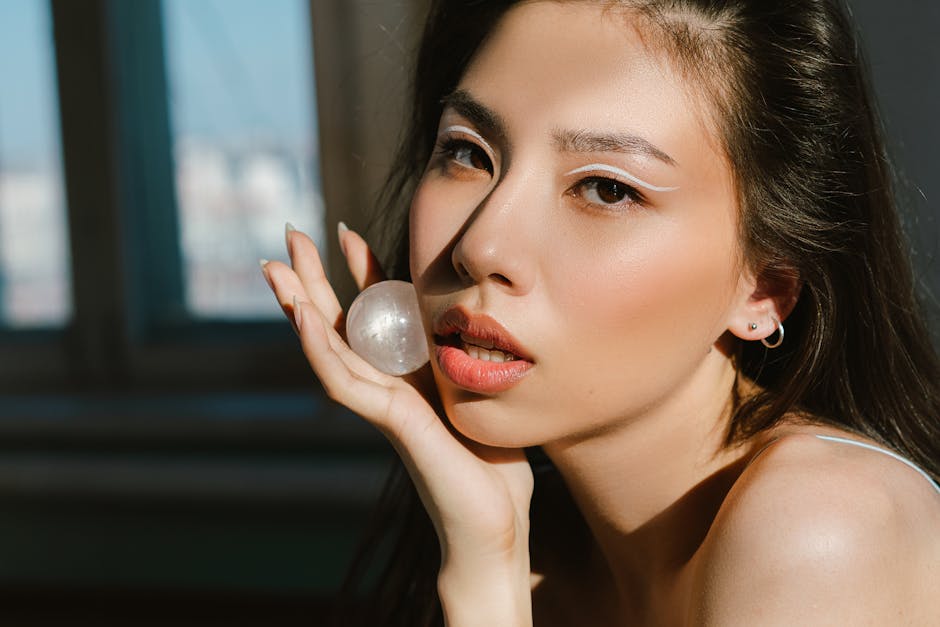
Moonstone Crystal: Meaning, Properties & Healing Benefits
This post contains affiliate links. If you purchase through these links, we may earn a small commission at no extra cost to you. Learn more.
Two thousand years ago, Roman naturalist Pliny the Elder recorded that moonstone’s shimmering interior shifted with the phases of the moon — a belief so persistent that ancient jewelers refused to set the stone unless the moon was waxing. That luminous internal glow, which modern gemologists call adularescence, still stops people in their tracks today. The moonstone crystal has been revered across cultures for millennia, and if you have ever held a fine specimen and watched that blue light roll beneath the surface like a wave caught in glass, you understand exactly why.
In this guide, I’ll walk you through everything you need to know about moonstone meaning, moonstone properties, moonstone benefits, and how to work with this extraordinary stone in your daily spiritual practice — listen to transformative spiritual audiobooks on Audible — whether you are drawn to it for its geological beauty, its connection to the divine feminine, or both. If you are just beginning to explore the world of healing crystals, our guide for crystal beginners is a wonderful companion to bookmark alongside this one.

Recommended Moonstone Products
These hand-picked products are selected for quality and value. As an Amazon Associate, we earn from qualifying purchases.


What Is Moonstone Crystal? Geology, Formation, and the Science of Adularescence
Moonstone is a member of the feldspar group of minerals — specifically a variety of orthoclase (potassium aluminum silicate) that forms in a distinctive intergrowth with albite (sodium aluminum silicate). According to the Gemological Institute of America (GIA), this internal layering of alternating feldspar phases is precisely what produces the stone’s signature optical phenomenon. As light enters the crystal, it scatters between microscopic layers spaced roughly 100 to 300 nanometers apart, producing a soft, three-dimensional billowing glow that appears to float just beneath the surface.
Our Top Moonstone Picks
We’ve hand-picked these products based on quality, reviews, and value. Prices and availability are updated regularly via the Amazon API.
Recommended Moonstone Products
Hand-picked for quality, reviews, and value — enhance your moonstone experience.


Prices updated via Amazon. As an affiliate, we earn from qualifying purchases.
The GIA classifies this effect as adularescence — named after the Adula Mountains in the Swiss Alps, where high-quality specimens were historically mined at a site called Mt. Adular. The finest moonstone displays a vivid blue sheen over a colorless, transparent body, a combination that commands the highest prices among gem collectors and remains the benchmark against which all other moonstone is measured.
Physical Properties at a Glance
Moonstone registers a Mohs hardness of 6 to 6.5, making it moderately durable but susceptible to scratching if handled carelessly alongside harder materials. Its crystal structure is monoclinic, and it has perfect cleavage in two directions, meaning it can chip or cleave if struck at certain angles. Despite this vulnerability, it has been fashioned into jewelry and sacred objects for thousands of years, most commonly cut as a cabochon to best display the adularescent effect across the stone’s domed surface.
According to the mineral database Mindat.org, moonstone occurs in pegmatites and low-grade metamorphic rocks and is found commercially in Sri Lanka, India, Madagascar, Myanmar, Tanzania, Brazil, and parts of the United States — notably Virginia and New Mexico. Sri Lankan material, sometimes called Ceylon moonstone, remains the global gold standard for gem-quality specimens, producing the most coveted blue-on-colorless adularescence. The United States Geological Survey notes that feldspar minerals, including the orthoclase that forms moonstone, are among the most abundant mineral groups in Earth’s crust, though gem-quality material with strong optical phenomena represents a tiny fraction of total production.
Rainbow Moonstone: A Beautiful Special Case
If you have shopped for moonstone recently, you have likely encountered rainbow moonstone, which displays a multicolored flash of blue, violet, and gold rather than a single blue sheen. Technically, gem-quality rainbow moonstone is a variety of labradorite — a different feldspar mineral — rather than true orthoclase moonstone. It is widely used in crystal healing under the moonstone umbrella, and both are genuinely beautiful minerals with overlapping metaphysical traditions. Just be aware of the distinction when purchasing, particularly if you are seeking a specific gemological variety. The rainbow variety’s spectral flash comes from a similar layering mechanism called labradorescence, and in my experience it carries a slightly more dynamic, activating energy than traditional white or blue moonstone.

Moonstone Meaning: History, Mythology, and Spiritual Significance
Few crystals carry as rich a mythological legacy as the moonstone crystal. Its association with lunar energy, feminine power, and intuitive wisdom spans at least two thousand years across vastly different cultures — a convergence that speaks to something universal in its appearance and in humanity’s relationship to the moon itself.
Ancient Rome and Greece: Solidified Moonlight
The Romans were among the most enthusiastic devotees of moonstone, believing it was literally formed from solidified rays of moonlight and associating it with their lunar deities — Diana, goddess of the moon and the hunt, and the Greek Selene who drove her silver chariot across the night sky. Pliny the Elder’s first-century encyclopedia Naturalis Historia describes moonstone as containing an image of the moon that grew and diminished with the lunar cycle, and recommends it as an amulet of great power.
Roman jewelers reportedly sold moonstone mounted in gold as love talismans, with the belief that holding the stone in one’s mouth during a full moon would reveal the future and bring lovers together. This use of moonstone as a romantic talisman persisted through the medieval period and into the Renaissance, where it appeared in herbalists’ texts and alchemical manuscripts alongside more familiar materials. Our article on crystals for love explores this tradition in the context of modern practice.
Hindu Tradition: The Sacred Dream Stone
In Hindu mythology, moonstone holds a place of profound reverence. Ancient Sanskrit texts describe it as chandrakanta — meaning “beloved of the moon” — and attribute its creation to solidified moonbeams that fell to earth and crystallized. It was considered sacred to the lunar deity Chandra and was believed to function as a dream stone, bringing beautiful visions and psychic revelations to whoever slept with it nearby. This tradition persists in South and Southeast Asia, where moonstone is incorporated into religious jewelry, ceremonial objects, and bridal adornment to this day.
The Smithsonian Institution’s National Museum of Natural History, whose mineralogy education resources document moonstone’s global cultural importance, notes that the stone has been treasured in both Eastern and Western traditions for at least two millennia — one of the more consistent cross-cultural gem preferences in recorded history.
The Art Nouveau Revival and Modern Resonance
Moonstone experienced a dramatic resurgence during the Art Nouveau movement of the late 19th and early 20th centuries. Jewelry masters including René Lalique and Georges Fouquet incorporated moonstone into their organic, nature-inspired designs, pairing it with enamelwork, horn, and plique-à-jour to create pieces of extraordinary delicacy. The stone’s ethereal, otherworldly quality aligned perfectly with the movement’s rejection of industrial rigidity in favor of flowing natural forms, and it became fashionable among European aristocracy and the creative avant-garde simultaneously.
Today, moonstone sits at an interesting intersection of geological science and spiritual tradition. The crystal healing community has embraced it as one of the quintessential feminine, lunar stones, while its adularescent beauty has made it a perennial favorite among jewelry designers from high fashion to artisan craft. That dual appeal — intellectual and intuitive, scientific and spiritual — is part of what makes moonstone crystal so enduringly compelling.
Moonstone Properties: Metaphysical Meaning and Healing Benefits
I want to be transparent about something before we go further: moonstone’s healing properties and metaphysical benefits are rooted in thousands of years of tradition and widely reported by contemporary practitioners, but they represent experiential and spiritual belief rather than clinically verified medical outcomes. That said, the consistency of what people report across cultures and centuries is remarkable and worth taking seriously on its own terms. With that context established, here is what working with moonstone crystal is traditionally understood to offer.
For a broader introduction to how healing crystals are used in modern practice, our guide to how to use crystals for healing provides an excellent foundation.
Intuition, Psychic Awareness, and Inner Vision
Moonstone is perhaps most universally recognized as a stone of intuition. Practitioners across traditions consistently report that working with it heightens sensitivity to subtle energies, deepens dream recall, and opens channels of inner knowing that might otherwise remain dormant beneath the noise of daily life. In my own experience, keeping a moonstone on the bedside table — particularly in the weeks around the full moon — noticeably enhances the vividness and narrative coherence of dreams. This aligns directly with the Hindu chandrakanta tradition and suggests a consistent experiential reality behind the ancient belief.
For those specifically seeking to develop their intuitive capacities, moonstone pairs beautifully with other crystals for intuition such as labradorite, amethyst, and lapis lazuli. The combination of moonstone and labradorite in particular is remarkably synergistic — both stones carry strong lunar and visionary associations and seem to amplify each other’s effects.
Emotional Balance and the Divine Feminine
Moonstone is strongly associated with the divine feminine principle — not as a strictly gendered concept, but as the universal quality of receptivity, nurturing, cyclical wisdom, and emotional depth that exists within all people. This makes it an exceptional crystal for anyone seeking greater harmony with their emotional landscape.
Practitioners report that moonstone helps soften emotional reactivity, encourages patience and compassion, and supports the healthy processing of grief, loss, and transitions. It is particularly recommended during periods of hormonal fluctuation and life transition — adolescence, pregnancy, postpartum recovery, perimenopause — as it is traditionally believed to attune the body and psyche to natural lunar rhythms. A 2019 qualitative study published in the Journal of Alternative and Complementary Medicine examining patient experiences with crystal therapy found that stones associated with lunar energy were among those most consistently described as helpful for emotional regulation and stress reduction, though the researchers noted the need for controlled trials. This is traditional belief supplemented by preliminary qualitative data — not a proven medical treatment — but worth noting as part of the evolving conversation around these practices.
New Beginnings and Manifestation Energy
Aligned with the new moon energy of planting seeds and setting intentions, moonstone is considered one of the premier crystals for new beginnings. If you are starting a new chapter — a relationship, a career pivot, a creative project, a geographical move — working with moonstone during the waxing moon phase is said to amplify the receptive, magnetic quality of your intentions and prepare you energetically for growth and change.
Its energy is naturally complementary to manifestation work. Holding a moonstone while journaling your goals, or placing it on your third eye during meditation while visualizing your desired outcomes, is a practice many crystal workers return to consistently. The stone’s traditional association with cycles and emergence makes it particularly suited to any intention that involves organic unfolding rather than forced action.
Chakra Connections
Moonstone resonates primarily with three energy centers in the body’s subtle anatomy:
- Third Eye Chakra (Ajna): Stimulates intuition, inner vision, and psychic perception. Moonstone placed on the third eye during meditation is one of the most direct methods for accessing its visionary properties.
- Crown Chakra (Sahasrara): Facilitates connection to higher consciousness, spiritual guidance, and the broader cycles of cosmic time. Particularly useful for those who feel spiritually disconnected or mentally scattered.
- Sacral Chakra (Svadhisthana): Supports emotional fluidity, creative expression, sensuality, and fertility. This chakra connection underlies moonstone’s longstanding use as a feminine stone and its association with the body’s cyclical processes.
For deeper work with these energy centers, our guides to third eye chakra stones and crown chakra stones offer specific pairing recommendations and activation techniques that work beautifully with moonstone as a foundational stone.
Types of Moonstone: A Complete Buyer’s Comparison Guide
Not all moonstone is equivalent, and understanding the major varieties will help you make confident purchasing decisions — whether you are shopping for metaphysical work, wearable jewelry, or collecting gem specimens.
| Type | Body Color / Sheen | Primary Origins | Best For | Relative Price |
|---|---|---|---|---|
| Blue Moonstone (Ceylon) | Colorless body, vivid blue adularescence | Sri Lanka | Gem-quality jewelry, intuition work, collectors | High ($$$–$$$$) |
| White / Cream Moonstone | White to cream, silver-white sheen | India, Madagascar | General healing, emotional balance, beginners | Accessible ($–$$) |
| Peach / Tan Moonstone | Warm peach to tan, soft sheen | India, Myanmar | Love, fertility, sacral chakra, divine feminine | Accessible ($–$$) |
| Gray Moonstone | Gray body, white to silver sheen | India, Madagascar | New beginnings, shadow work, transition | Accessible ($–$$) |
| Rainbow Moonstone (Labradorite) | White to clear, multicolor flash | India (Rajasthan), Madagascar | Chakra alignment, joy, protection, amplification | Accessible ($–$$) |
| Black Moonstone | Dark gray to black, silver-white sheen | Madagascar | New moon rituals, shadow work, grounding | Accessible ($–$$) |
When purchasing moonstone in any of these varieties, look for a strong, centered adularescent sheen that moves fluidly and three-dimensionally as you tilt the stone — the glow should appear to shift from within, not simply reflect off the surface. Avoid stones with heavy inclusions in the primary viewing area, dull or flat surfaces, or a uniformly perfect appearance with no internal texture whatsoever, which may indicate glass or synthetic material. A transparent seller will always disclose the country of origin, which matters both for quality assessment and ethical supply-chain considerations.
How to Use and Care for Moonstone Crystal
Moonstone is one of the more versatile crystals in any collection because it translates beautifully from formal meditation and moon rituals to everyday wearable jewelry and home decor. Here are the most effective and time-tested methods I have encountered in years of practice.
Wearing Moonstone Jewelry
Wearing moonstone close to the body is among the most effective ways to maintain consistent contact with its energy throughout the day. A moonstone bracelet worn on the left (receptive) wrist is the traditional choice for drawing in lunar energy and emotional nourishment. A moonstone pendant worn over the heart or throat area is particularly effective for emotional processing and authentic communication. A moonstone ring on the index finger is traditionally associated with intention-setting, leadership, and direction in many esoteric traditions.
Silver settings are particularly well-matched to moonstone — silver carries its own lunar associations in Western alchemy and amplifies the stone’s feminine energy — though gold and rose gold create beautiful contrast with warmer-toned peach or cream specimens. For comprehensive guidance on selecting crystal jewelry that serves both aesthetic and metaphysical purposes, our article on the best crystal jewelry covers quality markers and ethical sourcing considerations in depth.
Meditation with Moonstone
For dedicated meditation sessions, hold a tumbled moonstone in your non-dominant hand or place a flat piece on your third eye (the space between and slightly above your brows) as you lie down. Set a clear, specific intention before you begin — whether that is improving dream recall, releasing emotional tension, strengthening intuitive perception, or preparing to set new moon intentions. Allow 15 to 30 minutes, breathing slowly and letting the stone’s energy work without forcing or analyzing.
In my experience, moonstone meditation is most potent performed on or within two days of the full or new moon, when the stone seems to carry a noticeably heightened charge. Our detailed guide to meditating with crystals walks through the full setup and technique, including how to create a supportive space and how to journal your experiences afterward for deeper integration.
Moon Charging and Cleansing
Moonstone has an intuitive and profound affinity with moonlight. Placing it on a windowsill or outdoors under the full moon overnight is one of the most effective ways to both cleanse and recharge it simultaneously. Unlike some crystals that respond better to sunlight, moonstone thrives under lunar light, making this a natural and ideal method rather than a compromise. I leave mine out for the full night of the full moon and often for the night before and after as well, when the moon is at its brightest.
For routine cleansing between moon cycles, smudging with white sage, cedar, or palo santo is effective and gentle. Sound cleansing with a singing bowl or tuning fork is another excellent option that works beautifully without touching the stone. What to avoid: prolonged water soaking. While brief rinsing in clean water does not harm moonstone, extended immersion can penetrate along the stone’s natural cleavage planes over time and affect its polish. Our comprehensive guide to cleansing crystals covers all methods in detail with timing recommendations for each.
New Moon and Full Moon Rituals
Moonstone is purpose-made for lunar cycle work. On the new moon, hold your moonstone while writing down intentions and areas of life you wish to cultivate in the coming cycle. Speak your intentions aloud while holding the stone against your heart. On the full moon, hold it while reflecting on what you are ready to release — what patterns, relationships, or beliefs have reached their natural completion. The stone’s traditional role as a bridge between the conscious and the unconscious makes this kind of cyclical reflection feel genuinely supported and held rather than effortful.
Crystal Grid Integration
Moonstone serves beautifully as a center stone in crystal grids focused on love, intuition, or new beginnings. Pair it with rose quartz for heart-opening and emotional healing, amethyst for deepening psychic work, or clear quartz points to amplify and direct its energy outward through the grid. Its lunar energy functions as a harmonizing focal point, helping diverse crystal energies work in concert rather than at cross-purposes.
Top Moonstone Products: Our Recommended Picks
After years of working with moonstone and recommending it to students and clients, these are the product forms I return to consistently. All links below are Amazon affiliate links that cost you nothing extra.
1. Moonstone Bracelet — For Daily Wear
A stretch beaded moonstone bracelet is the most accessible entry point for wearable crystal healing. Look for natural, untreated moonstone beads with visible adularescence in the product photographs — not dyed or coated glass beads, which are frequently misrepresented as moonstone at low price points. Beads of 6mm to 10mm offer a good balance of visual impact and all-day wearability.
2. Rainbow Moonstone Tumbled Stones — For Meditation and Grids
A set of rainbow moonstone tumbled stones is a versatile, affordable entry point for working with moonstone energy in meditation, crystal grids, and pocket carry. Indian rainbow moonstone from Rajasthan is particularly well-regarded for the clarity of its blue-to-violet flash. Look for sellers who specify geographic origin and show actual stones rather than stock renders.
3. Moonstone Pendant — For Heart and Throat Chakra Work
A sterling silver-set moonstone pendant makes an exceptional daily talisman and a meaningful gift. Silver’s own lunar associations amplify the stone’s energy while providing a protective setting. Look for a cabochon-cut stone with a clearly visible sheen in product photos, and favor artisan or handmade settings for the most intentional craftsmanship.
4. Moonstone Ring — For Intention-Setting
Few pieces of jewelry are as visually striking as a well-set moonstone ring. For everyday wear, choose a bezel or semi-bezel setting that protects the stone’s edges — moonstone’s relative softness makes exposed prong-set stones more vulnerable to chipping during normal activity. Rose gold and yellow gold settings complement warmer-toned moonstone beautifully, while white gold and silver enhance the cool blue of Sri Lankan material.
Moonstone and Astrology: Zodiac Signs, Birthstone, and Planetary Rulership
Moonstone’s astrological correspondences are among the most deeply established of any crystal, woven into both Western and Vedic astrological traditions over centuries of use.
June Birthstone
Moonstone is one of three official June birthstones, alongside pearl and alexandrite, as recognized by both the American Gem Trade Association (AGTA) and the Gemological Institute of America in their jointly updated birthstone list. If you were born in June or are shopping for a June birthday, moonstone is a distinctive and meaningful alternative to pearl — and its geological uniqueness makes it a genuinely interesting gift for anyone curious about the natural world. Its price range is also far more accessible than fine alexandrite at comparable quality levels.
Zodiac Sign Affinities
Moonstone carries particular resonance for three zodiac signs, though anyone drawn to its energy can work with it productively regardless of their birth chart:
- Cancer (June 21 – July 22): As the zodiac sign ruled by the moon, Cancer has the deepest natural affinity with moonstone. The crystal amplifies Cancerian intuition, nurturing capacity, and emotional intelligence while offering gentle support for the sign’s tendency toward emotional overwhelm and over-absorption of others’ feelings.
- Libra (September 23 – October 22): For balance-seeking Libra, moonstone supports clearer emotional decision-making, harmonious relationship energy, and the kind of patient receptivity that allows this often externally-focused sign to hear its own inner voice.
- Scorpio (October 23 – November 21): Moonstone softens Scorpio’s intensity while amplifying its natural psychic gifts and penetrating perception. It is particularly useful for Scorpio during periods of emotional transformation, which this sign tends to encounter more frequently than most.
For a full exploration of crystals matched to your birth sign and how to work with them through the year, our comprehensive zodiac crystals guide covers all twelve signs with specific recommendations.
Planetary Rulership: The Moon
In classical astrological mineralogy, moonstone is one of the primary stones of the moon, alongside selenite and pearl. Working with moonstone is said to harmonize one’s natal moon energy — the emotional body, instinctive responses, relationship to cycles of growth and release, and the quality of inner nourishment one gives oneself. This makes it particularly valuable for anyone whose moon sign is in tension with their sun sign, or who is working through patterns established in childhood around emotional safety and belonging. Our dedicated article on moon crystals explores this connection alongside other lunar stones and their complementary properties.
Frequently Asked Questions
More Moonstone Essentials
Complete your collection with these highly-rated picks.


Prices updated via Amazon. As an affiliate, we earn from qualifying purchases.
Moonstone crystal is best known spiritually as a stone of intuition, divine feminine energy, and emotional balance. It is traditionally used to enhance psychic awareness, improve dream recall, support intentions around new beginnings, and deepen connection to lunar cycles and inner wisdom. Practitioners across Hindu, Roman, and modern Western esoteric traditions consistently describe it as a conduit for inner knowing, emotional intelligence, and the kind of receptive consciousness that allows spiritual insight to arise naturally. It is also strongly associated with the goddess archetype in its many cultural forms — Selene, Diana, Hecate, Chandra — making it one of the most potent stones for anyone working within a lunar or goddess-centered spiritual framework.
Genuine moonstone displays adularescence — a soft, three-dimensional glow that appears to float beneath the surface of the stone and shifts as you tilt it. This internal movement is not found in glass imitations, which tend to show surface reflections or static color rather than a subsurface glow. Real moonstone is also cool to the touch and warms slowly in your hand, whereas glass equilibrates to body temperature more quickly. Under magnification, you may observe characteristic stress fractures along the stone’s natural cleavage planes, sometimes called centipede inclusions — these are actually a sign of genuine moonstone rather than a flaw. If a stone has a perfectly uniform, flat, glassy color with no internal movement or character, treat it with skepticism. Purchasing from reputable gemological dealers, established crystal shops, or sellers who can provide certificates of authenticity for high-value pieces is always the safest approach.
Yes, with appropriate care and thoughtful setting choice. Moonstone’s Mohs hardness of 6 to 6.5 means it can be worn daily but requires more mindfulness than harder stones such as sapphire, ruby, or diamond. It is best set in protective bezels rather than prong settings, kept away from ultrasonic cleaners and harsh chemical cleaning products, and removed before activities that risk impact — gardening, sport, weight training, cooking with heavy pots. Wiping it clean with a soft damp cloth and storing it separately from harder stones will preserve its polish for years of daily wear. Many people wear moonstone rings or bracelets every day without issue simply by treating the piece with reasonable care.
In the United States, moonstone is available at most crystal shops, metaphysical retailers, gem and mineral shows, and artisan jewelry boutiques in most cities. Major metropolitan areas — New York, Los Angeles, Chicago, Denver, Portland, Austin, Seattle, and Asheville — have particularly thriving crystal retail communities with multiple options for in-person purchase, which has the significant advantage of letting you observe the adularescence directly before buying. The Tucson Gem and Mineral Show, held every February in Tucson, Arizona, is one of the world’s largest gem trade events and an extraordinary source for both gem-quality and affordable moonstone from verified origins. For online shopping, our guide to buying crystals online offers practical guidance for evaluating sellers and avoiding common pitfalls with synthetic or mislabeled material.
Moonstone is a harmonious partner for many crystals, and pairings can be refined to match your specific intention. For deepening intuition and psychic development, combine it with labradorite, amethyst, or lapis lazuli — all carry strong visionary associations that complement moonstone’s receptive quality. For love, emotional healing, and heart-opening work, rose quartz and rhodonite are natural companions. For manifestation and new beginnings, clear quartz amplifies moonstone’s energy and direction while citrine adds activating solar energy to balance the lunar receptivity. For anyone working through emotional upheaval, anxiety, or grief, moonstone pairs particularly well with the best crystals for anxiety — lepidolite, blue lace agate, and amazonite create a supportive, calming field when combined with moonstone’s emotional wisdom.
Final Thoughts on Moonstone Crystal
Moonstone is one of those rare crystals that earns its reputation at every level of engagement — geological, historical, and experiential. Its adularescent glow is not merely beautiful; it is a physical manifestation of the interplay between internal structure and light that makes mineralogy as captivating as any art form. And for those drawn to its metaphysical dimension, the consistency with which moonstone surfaces in traditions as geographically and culturally distant as first-century Rome and classical India suggests that something genuinely resonant lives within this stone.
Whether you are drawn to moonstone crystal for its luminous beauty, its profound connection to lunar cycles and the divine feminine principle, or its longstanding reputation as a stone of intuition and new beginnings, it is a worthy and meaningful addition to any collection. Start with a tumbled stone or a simple piece of moonstone jewelry and spend one full lunar cycle — new moon to new moon — observing what shifts in your emotional awareness, dream life, and inner voice. I think you will find, as countless practitioners across millennia have before you, that this stone has a distinctive way of meeting you exactly where you are.
Last Updated on March 21, 2026
Amber, a certified crystal healer and spiritual teacher, shares her decade-long expertise on CrystalsAlchemy.com. Passionate about the transformative power of crystals, she helps others lead balanced lives through personal growth, spiritual development, and holistic well-being.
Related Posts:


We include products we think are useful for our readers. If you buy through links on this page, we may earn a small commission at no extra cost to you.
All content is strictly for informational purposes only and does not constitute legal, medical or other expert advice.
This article was originally published on
Looking for the perfect gift idea this holiday season? Try this free Gift Suggestion Tool. Giftly.ai is an intuitive tool personalizes gift suggestions based on a person's interests and your budget, streamlining your shopping experience. Try it now, and experience the ease of finding the ideal gift in seconds!


