Moldavite Crystal: Meaning, Properties & Healing Guide
Most crystals form slowly underground over millions of years. Moldavite is the exception. It came down through the sky.
Roughly 14.7 million years ago, a meteorite struck what is now southern Germany. The impact vaporized the local sandstone, flung molten droplets hundreds of kilometers across central Europe, and those droplets cooled in mid-air into the bottle-green natural glass we now call moldavite. It is found in only one place on Earth: the Czech Republic and a sliver of Austria. Nowhere else. That single-locality reality is why moldavite has become one of the most coveted, mythologized, and counterfeited stones in the modern crystal market.
This guide is the canonical resource for everything moldavite: the geology behind it, the four specimen types you will see for sale, how to spot a fake, what the famous “moldavite flush” actually feels like, how to use it responsibly, and which companion stones temper its intensity. Every product link points to authenticated, locality-verified specimens, because moldavite fakes outnumber real pieces by a wide margin.
In This Guide
✨ Editor’s Pick: Authenticated Besednice Moldavite
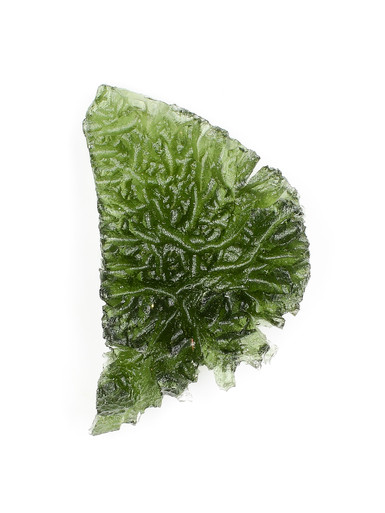
A collector-grade Besednice specimen from Karlovy Vary. Tortured fern texture, deep bottle-green, 41.6 carats. Authenticated and locality-tagged.
See the hand-selected specimen →Moldavite Profile at a Glance
- Mineralogy: Tektite (impact-formed natural glass, not a true crystal)
- Chemistry: Mostly silicon dioxide (SiO2) with aluminum, magnesium, iron oxides
- Mohs hardness: 5.5 to 6 (softer than quartz, can chip)
- Color: Bottle green, mossy green, olive, occasional brown
- Locality: Czech Republic (Bohemia, Moravia) and a small Austrian field. Nowhere else on Earth.
- Age: Approximately 14.7 million years old
- Chakras: Heart, third eye, crown
- Element: Storm (combined air, fire, water, earth)
- Zodiac: All signs, traditionally associated with Aquarius and Scorpio
- Planet: Cosmic, often linked to Uranus and Pluto for transformation
The Quick Answer: Moldavite at a Glance
Moldavite is a green natural glass born from a meteorite impact 14.7 million years ago. It is found only in the Czech Republic and a tiny corner of Austria, which makes it the only single-locality stone in the modern healing crystal trade. Practitioners call it the Stone of Transformation because its energy signature is famously fast, hot, and disruptive in a useful way. People wear it to accelerate spiritual growth, break out of stuck life patterns, and crack open the heart and third eye chakras.
The catch: counterfeits flood the market, prices have climbed sharply since 2020, and the so-called moldavite flush, an intense heat-and-tingle reaction, can overwhelm beginners. This guide covers all of it: the science, the four specimen tiers, fake-detection, side effects, companion stones, and care.
| Specimen Type | Surface | Price Tier | Best For |
|---|---|---|---|
| Besednice | Sharp fern-like etching | $300 to $1500+ | Collectors, display |
| Chlum | Rolling pitted texture | $60 to $500 | Working specimens |
| Slavče | Smoother, paler green | $50 to $300 | Entry pieces |
| Museum-grade | Large, intact, rare textures | $2000+ | Investment pieces |
What Is Moldavite, Really?

Moldavite is a tektite. Tektites are bodies of natural glass formed by meteorite impacts, where extreme heat and pressure vaporize the local rock and fuse it back together as it cools. Moldavite specifically formed when a large stony meteorite slammed into the Ries crater area in southern Germany roughly 14.7 million years ago. Molten ejecta sprayed in an arc across what is now Bohemia, Moravia, and a fringe of Austria, then cooled mid-flight into the lumpy green nuggets we recognize today.
Chemically, moldavite is mostly silicon dioxide (about 70 to 80 percent), with aluminum oxide, iron oxide, magnesium, calcium, and potassium making up the rest. The trace iron is what gives it the bottle-green color. Because it is amorphous glass rather than a crystallized lattice, mineralogists technically classify it as a mineraloid, not a crystal. That distinction matters when you read suppliers describing the “crystalline structure,” because moldavite has none. It is frozen liquid.
The Difference Between Tektite and True Crystal
A true crystal like quartz or amethyst grows atom by atom in a repeating geometric lattice. Moldavite never had time for that. It went from molten silicate to airborne droplet to cooled glass in seconds. The internal structure shows lechatelierite inclusions (fused quartz strings), schlieren (flow lines), and tiny gas bubbles. These are the fingerprints of a violent, fast cool, and they are also one of the easiest ways to confirm a piece is real under a loupe.
The Bohemian Origin Story

Moldavite gets its name from the Moldau River (Vltava in Czech), which runs through the strewn field where the largest pieces were first documented. The earliest scientific description came from Josef Mayer at the University of Prague in 1786. Local farmers had been turning up the green stones in fields around Týn nad Vltavou for centuries before that, sometimes wearing them as folk amulets, sometimes carving them into talismans associated with fertility and good fortune.
There are four documented strewn-field areas: South Bohemia (the Besednice and Chlum fields, where most premium specimens come from), Moravia (smaller, often paler stones), Lusatia in eastern Germany, and a tiny field in Lower Austria. The total mass of moldavite still in the ground is finite. Estimates from Czech geologists suggest the original impact produced roughly 275 tons of moldavite, of which a fraction has ever been collected. The Czech government regulates mining tightly, which is why prices have climbed steadily as easy-collect surface material runs out.
Why “Single Locality” Matters
Most popular healing stones come from many places. Amethyst is mined in Brazil, Uruguay, Zambia, Russia. Quartz is everywhere. Moldavite is the rare exception: there is no Brazilian alternative, no Madagascar mine, no Chinese deposit. If a seller offers “African moldavite” or “Indonesian moldavite,” it is not moldavite. It might be obsidian, slag glass, or molded green glass, but the geology rules out any other origin.
Moldavite Healing Properties & Spiritual Effects
Among working crystal practitioners, moldavite has a reputation that lands somewhere between revered and feared. The shorthand version: it works fast and it does not negotiate. Where rose quartz invites and gradually softens, moldavite arrives as a kind of energetic crowbar. People report sudden career pivots, relationship endings, abrupt clarity about decisions they had been postponing. The spiritual community calls this acceleration, and the catalyst quality is why moldavite earned the nickname Stone of Transformation.
Heart Chakra Activation
Moldavite’s most consistently reported effect is heart chakra activation. The green color carries the chromatic frequency of the heart center, and many practitioners feel the warmth begin in the chest before it spreads outward. This is the doorway through which long-suppressed emotions tend to surface, sometimes within hours of first contact.
Third Eye and Crown Connection
Beyond the heart, moldavite reaches up to the third eye chakra and crown chakra. Practitioners use it to expand intuition, deepen meditation, and open channels for what they describe as cosmic downloads. People with prior experience in chakra work report that moldavite makes the upper energy centers feel “online” in a way that other stones approach more gradually.
The “Cosmic Origin” Energy Signature
Practitioners who work with high-vibration stones often describe moldavite’s energy as off-planet, distinctly different from terrestrial crystals. The reasoning, whether you take it metaphorically or literally, is that moldavite carries the imprint of the impact event itself: the meteorite’s frequency fused with terrestrial silicate. That cross-source signature is why moldavite is paired so often with star sign work, with high-vibration stones, and with practices that involve perceived contact with non-physical intelligence.
Heart resonance, third eye opening, crown chakra unlock. Element: storm.
The 4 Types of Moldavite Specimens You Will See
Once you start shopping, you will discover the moldavite market is not one product but four, each with its own surface signature, price band, and use case. Knowing which type you are looking at protects you from overpaying and from buying glass that has been cut to imitate a more expensive grade.
Besednice Moldavite (Premium Tier)
Besednice pieces come from the small Besednice field in South Bohemia. They are prized for the deeply etched, fern-like surface texture that no other moldavite locality produces. Color tends to be deeper green, the pieces are usually small (under 30 carats), and they command the highest prices in the market. Collectors treat Besednice the way mineral specimen buyers treat Brazilian aquamarine: peak example of the type.
Besednice Tier Pick
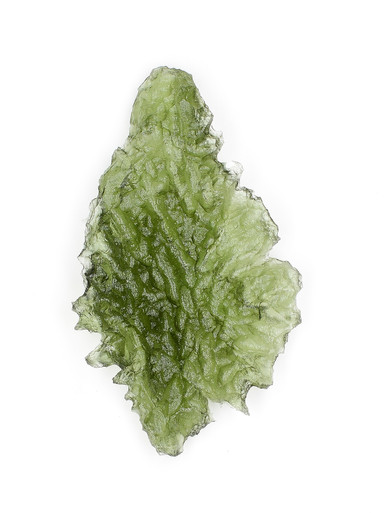
Classic Besednice with the deeply etched, fern-like surface that defines the type. 22.85 carats, Czech locality verified.
See the verified Besednice →Chlum Moldavite (Standard Working Tier)
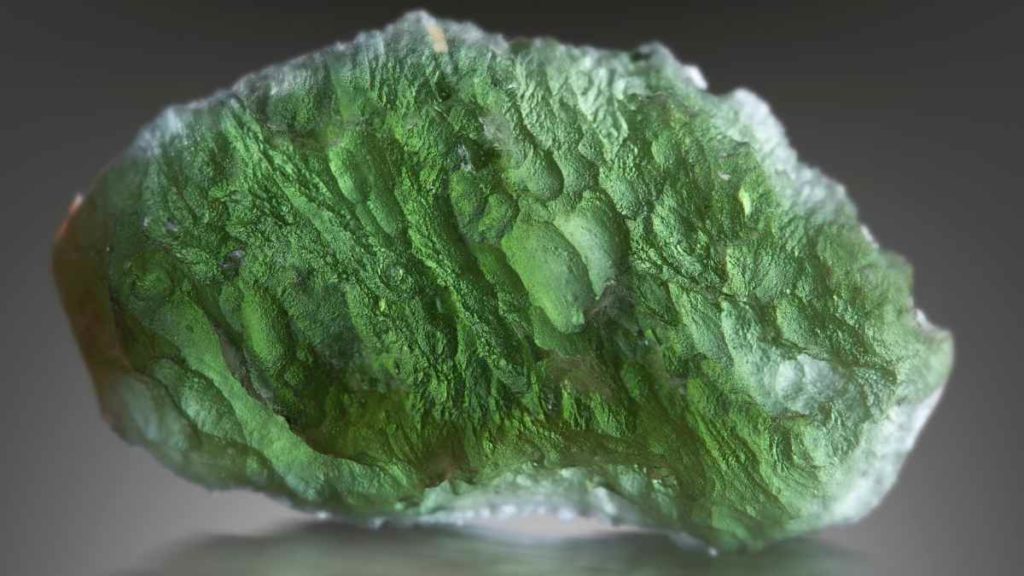
Chlum-area moldavite is what most working practitioners actually use. The surface is smoother and more rolling than Besednice, with classic pits and flow grooves. Color ranges from medium green to mossy olive. Sizes can run larger, which makes Chlum the practical choice for grid centerpieces, palm meditation, and anyone who wants real moldavite without the Besednice premium.
Chlum Tier Pick
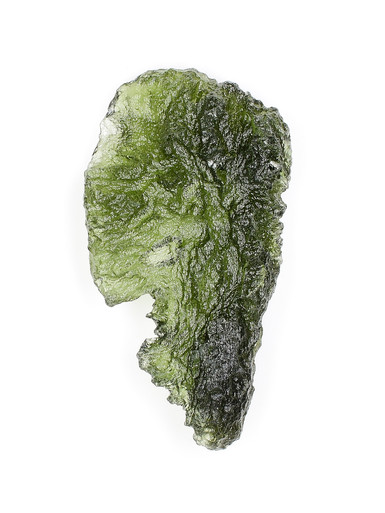
Authentic Chlum-area moldavite. Smoother surface than Besednice, classic translucent green. 32.55 carats.
See the verified Chlum specimen →Slavče Moldavite (Entry Tier)
Slavče-field stones are typically smoother again, with paler color and less dramatic surface. They are the most affordable tier of authentic Czech material, and they make sensible first pieces. Slavče is also the moldavite tier where you will see more cabochons and pendants cut, because the smoother starting material polishes well.
Entry Tier Pick
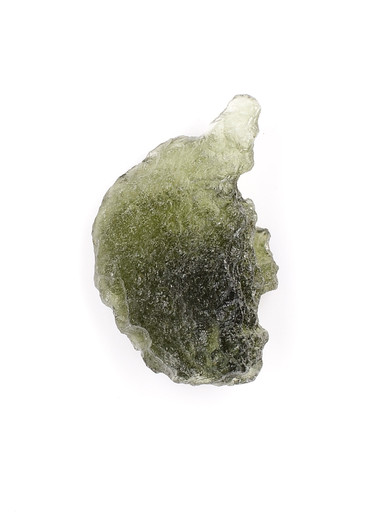
Entry-level authenticated moldavite, locality-verified. Good first piece for meditation work without jumping to collector tier.
See the locality-verified piece →Museum-Grade and Cabochon-Cut Specimens
At the top of the market are museum-grade pieces: large intact stones (50+ carats), unusually deep colors, and rare textures like the so-called “ripple” or “hedgehog” surface. These cross into investment territory. Separately, polished cabochons sit in their own niche: still authentic moldavite, but cut for jewelry settings rather than collected as raw specimens.
Polished Cabochon Pick
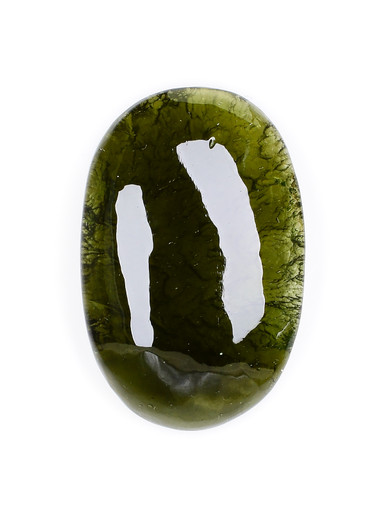
Polished cabochon top with natural-textured back. Best-of-both-worlds for jewelry settings or palm-stone meditation.
See the polished moldavite →Color signature: deep bottle green. Element: storm. Each tier carries the same core energy, the difference is surface, size, and price.
How to Use Moldavite

Wearing Moldavite
A moldavite pendant near the heart center delivers the most consistent reported effects. Many practitioners start with short sessions, an hour at first, building up over days. Earrings and rings work too, with rings tending to feel more grounding because the energy enters through the hand rather than the upper chest. Sterling silver settings are standard because the metal itself is energetically neutral.
Wearable Pick
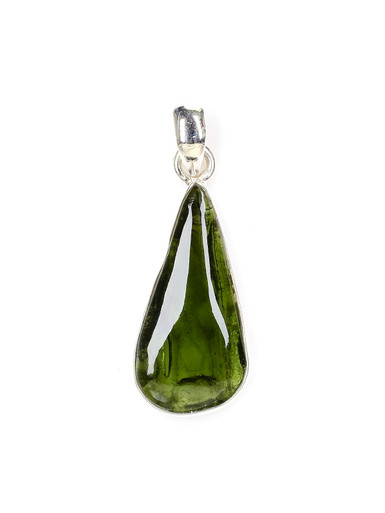
Wearable moldavite in 925 sterling silver. Polished cabochon front, textured natural back, ready to thread on a chain.
See the silver-set pendant →Meditation Practice
For meditation, hold a small piece in your dominant hand or place it over the heart while lying down. Beginners are often surprised by how quickly heat or tingling sensations build. Five-minute sessions are plenty in the first week. Extended sessions are for people who already have a steady meditation practice.
Crystal Grids and Layouts
Moldavite anchors transformation grids exceptionally well. Place a piece in the center of a layout designed for a specific change, surrounded by clear quartz points that amplify intention outward. Pair with rose quartz at the heart and selenite for cleansing. Run the grid for a moon cycle. Practitioners report that grids built around moldavite feel “louder” energetically than the same grid using clear quartz alone, which tracks with the broader pattern that moldavite intensifies whatever it is paired with.
Journaling and Integration
A practical, often-overlooked use: keep a journal during the first weeks of working with moldavite. The stone tends to surface dreams, memories, and decisions that have been buried. Writing them down, even briefly, helps the integration process and prevents the overwhelm reports that beginners sometimes describe.
How to Spot Real Moldavite vs. Fake

Counterfeit moldavite is everywhere. Industry estimates put the fake-to-real ratio in online marketplaces at somewhere between 5:1 and 10:1. The most common fakes are bottle-green molded glass and Chinese “moldavite” that is actually slag glass from industrial furnaces. Knowing the tells protects your wallet and your energy work.
The Visual Test
Real moldavite has irregular, organic surface texture: pits, grooves, fern-like etching, flow lines. The texture is never uniform across the stone. Fake glass tends to look molded, with smooth featureless surfaces or repeating bubble patterns. Color in real moldavite varies from bottle green to mossy olive to occasional brown, and it is rarely uniform within a single piece. Cheap fakes tend to be too uniformly green, often a slightly off neon shade.
The Loupe Test
Under 10x magnification, real moldavite shows lechatelierite inclusions (white wormy strings of fused quartz), small gas bubbles, and schlieren flow patterns. Glass fakes either show no inclusions at all (perfectly clear) or perfectly round identical bubbles (mass-produced glass).
The Weight and Hardness Test
Moldavite is moderately light. Specific gravity is around 2.32 to 2.38, which is lighter than many fake glasses pumped with denser additives. Hardness is 5.5 to 6 on the Mohs scale. A steel knife will scratch fake plastic resin “moldavite” easily but will struggle to mark real moldavite or real glass.
The Locality and Documentation Test
The best protection is buying from dealers who tag specimens by Czech locality (Besednice, Chlum, Slavče, Vrábče) and who can provide provenance. Locality-tagged moldavite is dramatically less likely to be counterfeit. Cheap “moldavite” listings from generic Asian marketplaces with no locality information are nearly always fake.
Authenticated Source Pick
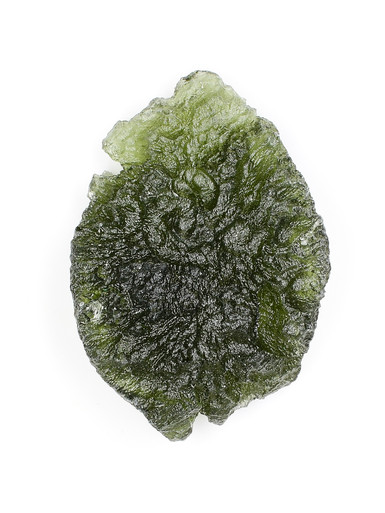
A heftier Chlum specimen at 48.45 carats. Strong green translucency, ideal for grid centerpieces.
See the locality-tagged moldavite →The Moldavite Flush: Side Effects & Integration

The “moldavite flush” is the term practitioners use for the immediate physical reaction many people experience on first contact. Common reports include: a heat sensation starting at the heart and spreading outward, tingling in the hands and crown, light-headedness, racing thoughts, sudden emotional release, and occasionally nausea or sleep disruption in the first 48 hours.
Why It Happens
The flush is not mystical signaling, it is the same kind of nervous-system response that some people get from intense breathwork or sudden cold exposure. The combination of expectation, attention, and the stone’s reputation for “cosmic” energy primes the body to register sensations that might otherwise pass unnoticed. Whether you frame it as energy work or autonomic response, the practical result is the same: take it seriously, do not push through it.
Who Should Be Cautious
People new to crystal work, anyone going through major life transitions already, those with a tendency toward anxiety, and people sensitive to energy practices should start small. A short pendant session, a few minutes of meditation, observation. The stone is not for everyone, and forcing it does not produce better results.
Integration Tips
Hydrate. Sleep. Keep grounding stones nearby (black tourmaline and hematite both work well). Limit moldavite contact to 30 to 60 minutes for the first week. Take days off. Notice what surfaces in dreams. The stone’s reputation for transformation is not a marketing line, real shifts can happen, and the integration is the work.
Companion Crystals That Balance Moldavite
Moldavite is rarely worked alone. Its energy is so directional that practitioners almost always pair it with stabilizing or amplifying companions. Four stones consistently top the list.
Black Tourmaline (Grounding)
The single most important moldavite companion. Black tourmaline grounds excess energy and provides the protection that lets moldavite’s acceleration work without spinning into overwhelm. Wear a black tourmaline bracelet on the opposite hand from any moldavite ring. Place a piece in your work area.
Grounding Companion Pick

Black tourmaline bracelet to anchor moldavite’s rocket-fuel energy back to earth.
Get a special 10% off at Energy Muse →Clear Quartz (Amplification)
Clear quartz amplifies and clarifies moldavite’s direction. Where moldavite is intense and unfocused, clear quartz adds intentionality. Stand a clear quartz point next to a moldavite specimen on an altar or grid.
Amplifier Pick

Clear quartz amplifier piece, perfect partner for moldavite when you want intentions amplified.
Get a special 10% off at Energy Muse →Amethyst (Integration)
Amethyst smooths the transition between moldavite’s intensity and ordinary daily awareness. It carries the third eye chakra activation that pairs naturally with moldavite’s crown work, and the violet frequency tempers the stone’s rocket-fuel quality.
Integration Pick

High-grade amethyst point that integrates the cosmic-download intensity of moldavite.
Get a special 10% off at Energy Muse →Rose Quartz (Heart Softening)
When moldavite cracks the heart open, rose quartz is the soft landing. Many practitioners keep a rose quartz heart in a meditation space specifically for moldavite work, returning to it when the activation feels too sharp.
Heart-Softening Pick

Hand-carved rose quartz heart, the soft-landing companion when moldavite work cracks the heart open.
Get a special 10% off at Energy Muse →Caring for Moldavite

Cleansing Without Water
Skip the running water method. Moldavite is glass, and prolonged water exposure (especially with mineral content) can pit the surface over time. Use sound (singing bowl, tuning fork), smoke (sage, palo santo, frankincense), or a selenite charging plate. Moonlight overnight is a classic moldavite cleansing method, particularly under a full moon.
Charging
Sunlight charges moldavite well, and unlike with amethyst, the green color does not fade. Two to three hours of morning sun is enough. You can also program the stone with intention by holding it during a focused meditation, stating the intention out loud or silently three times.
Storage and Breakage Risk
Moldavite is harder than common glass but it is still glass. It chips and breaks if dropped on hard surfaces. Store specimens individually, ideally on soft cloth or in a velvet pouch. Pendants should not be worn during sleep or vigorous activity. A cracked moldavite is not energetically broken (Czech folk tradition explicitly says it remains potent), but a chipped specimen loses display and resale value sharply.
The Bottom Line
Moldavite is the most distinctive single stone in the modern crystal market: cosmic origin, single locality, finite supply, and a reputation for accelerating change that holds up in practitioner experience. The catch is that the same factors that make moldavite unique also make it the most counterfeited stone in the trade.
If you want one piece to represent the category fully, choose a Besednice specimen with locality documentation. The classic fern-etched surface is what makes the type instantly recognizable, the Czech provenance protects against fakes, and the energetic signature is the strongest you will find at any tier. For practical daily work, a Chlum-area piece in the $200 to $400 band is the standard practitioner choice. For wearable use, a sterling-set cabochon pendant balances authenticity against breakage risk.
Pair whatever you choose with a black tourmaline grounding companion, take the moldavite flush seriously, and treat the first month as integration time. The stone’s reputation for transformation is real. Plan accordingly.
For more depth, see moldavite effects on the body and mind, the activation walkthrough at how to activate moldavite, and the broader heart chakra stones roundup.
Editor’s top pick across the whole range: the locality-tagged Besednice specimen featured at the top of this guide. Best combination of authenticity, surface character, and resale stability.
Related Guides
Frequently Asked Questions
Is moldavite really from a meteorite?
Yes, but indirectly. Moldavite formed from terrestrial rock that was vaporized by a meteorite impact roughly 14.7 million years ago, then cooled into glass droplets mid-flight. So while moldavite itself is not extraterrestrial material, it would not exist without the impact event and carries the chemical fingerprint of that violence.
How can I tell if my moldavite is real?
Check four things: irregular organic surface texture (real moldavite is never molded-smooth), lechatelierite inclusions visible under a 10x loupe, weight that matches a specific gravity around 2.35, and locality documentation from a reputable Czech-source dealer. Generic Asian-marketplace listings without locality tags are almost always fakes.
Why is moldavite so expensive?
Moldavite is found in only one place on Earth, the original supply is finite (estimated at roughly 275 tons total), the Czech government regulates extraction, and demand has surged sharply since 2020. Together those factors push prices up year over year, with no chance of new sources opening.
What is the moldavite flush?
The “moldavite flush” is the immediate heat, tingling, light-headedness, or emotional release many people report on first contact with the stone. Whether you frame it as energy work or autonomic nervous-system response, the practical advice is the same: start with short sessions, hydrate, and take days off if it feels intense.
Can I wear moldavite every day?
Many practitioners do, but most recommend building up gradually. Start with one-hour sessions for the first week, then extend to half-days and full days as tolerated. If you notice sleep disruption or persistent agitation, scale back. Moldavite does not need to be worn constantly to keep working.
Which crystals pair best with moldavite?
Black tourmaline for grounding, clear quartz for amplification, amethyst for integration, and rose quartz for heart softening. Black tourmaline is the most universal pairing because it tempers the rocket-fuel quality without dimming the work.
Can I cleanse moldavite with water?
Brief rinses are fine, but skip prolonged water cleansing. Moldavite is glass, and mineral-rich water can pit the surface over time. Use sound, smoke, selenite plates, or moonlight instead.
What chakras does moldavite work with?
Primarily the heart chakra, third eye, and crown. The green color resonates with the heart center, while the high-vibration character extends activation up through the upper energy centers. Practitioners often describe moldavite as connecting all three at once rather than focusing on a single chakra.
Is Besednice moldavite worth the premium?
For collectors, yes. The fern-etched surface is unique to the Besednice field and represents the most recognizable type. For practical practitioner use, a Chlum-area piece at a third the price delivers the same energetic signature. The premium pays for surface character and resale stability, not for stronger energy.
Can moldavite break easily?
Yes. Moldavite is glass with a Mohs hardness of 5.5 to 6, so it chips and breaks if dropped on hard surfaces. Store specimens individually on soft cloth, remove pendants for sleep and sport, and treat polished cabochons as you would any glass jewelry.
Sources & References
Sources & References
Editorial standards: every moldavite specimen featured in this guide is locality-tagged and authenticated by ExquisiteCrystals.com. See our editorial policy for sourcing standards.
- Hall, Judy. The Crystal Bible: A Definitive Guide to Crystals. Godsfield Press, 2003.
- Simmons, Robert, and Naisha Ahsian. The Book of Stones: Who They Are and What They Teach. North Atlantic Books, 2007.
- Gienger, Michael. Healing Crystals: The A-Z Guide to 555 Gemstones. Earthdancer Books, 2014.
- “Moldavite.” Mindat.org, https://www.mindat.org/min-2729.html. Accessed 22 April 2026.
- Trnka, Milos, and Stanislav Houzar. “Moldavites: a Review.” Bulletin of the Czech Geological Survey, vol. 77, no. 4, 2002, pp. 283-302.
- “Ries Crater.” Lunar and Planetary Institute, https://www.lpi.usra.edu/exploration/training/illustrations/europeanCraters/. Accessed 22 April 2026.
- “Tektite.” Encyclopaedia Britannica, https://www.britannica.com/science/tektite. Accessed 22 April 2026.
Last Updated on April 24, 2026
We may earn a commission from links on this page at no extra cost to you. This helps us keep CrystalsAlchemy running.
This article was originally published on